Random Plug: Traits of WoW Officers

Kreeoni wrote a list post disguised as a non-list post about the traits of WoW Officers. Those of you unfamiliar with him and his work, he’s another blogging Guild leader. I randomly stumbled across him one day on Twitter. I was intrigued and started following him.

Now if it were me, I would’ve titled it something like “7 Universal Traits of WoW Officers”. Number + Catchy line = Eyebrow raising interest.

A good post by a good blogger! We could use more GM blogs around.

Virtual Race Relations Part 1: Elves

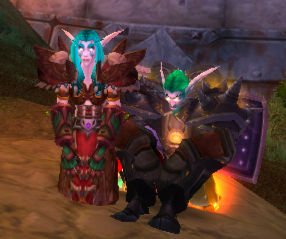
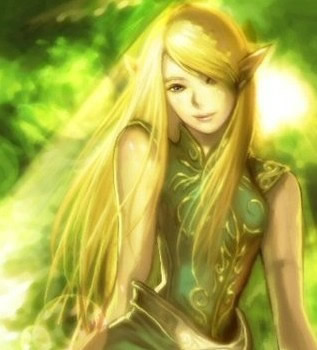
So, why is it that World of Warcraft players love elves so much? What is the mysterious attraction of these slender, blank-eyed character models? Whether we’re playing the characters ourselves, or just watching level one Night Elf chicks dance naked on the mailbox, World of Warcraft players seem extraordinarily little resistance to the charms of pointy-eared humanoids.

This post is the first in a series of features on the different playable races of World of Warcraft. In each post, I speculate about why we make the choices we make, and what social meanings our preferences might have. After all, I’m not the first to suggest that our actions in the virtual world reflect our real-life identities.

The Elves of Warcraft

Elven-folk in the World of Warcraft divide into two playable categories, Night Elves and Blood Elves. Even though their artistic style and character models differ somewhat, I find it most convenient to talk about them together. In the end of the article, I will speculate about the reasoning behind the difference in look, but first I’d like to talk about elves–and their magical appeal–more generally.

Elves in folklore

The elves, like many other stock personae of folklore, vary greatly from culture to culture. Generally of northern and western European extraction, the elves of folklore can be very small or human-sized, good or evil, ugly or beautiful. Elves are, at times, indistinguishable from fairies or other strange, supernatural creatures. All tales of elves have a common thread–their difference from humans. While they to some degree look and act human, and can even interbreed with them, elves have a different psychological makeup, different capabilities, and different values. To the ordinary human being, elves are all but unfathomable.

The debt to Tolkien

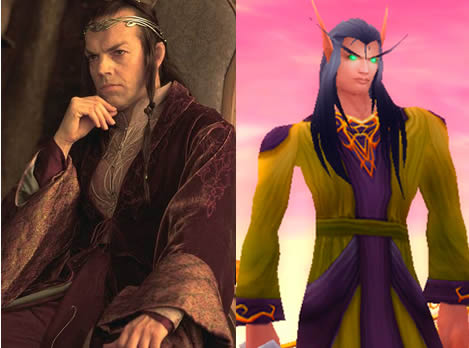
Most players of World of Warcraft could probably tell you that elves in-game descend more or less directly from J.R.R Tolkien’s elves. The elves of Middle-Earth are beautiful, powerful, benevolent beings, who despite their wisdom and good intentions, never seem to fully engage in the actions of the plot. The elves of Middle Earth–as both the book and the film poignantly depict–progressively abandon the continent in the midst of the conflict over the ring. As a first-time Tolkien reader, at age 16 or so, I was fascinated by Elrond, Galadriel, and Arwen. The sense of melancholy, of loss that haunts the elves is rather poignant, especially to the overly emotional teenage mind. However, ten years later, re-reading the novels makes me want to shake the elves for being so passive.

I think Peter Jackson must have agreed with me. In his film, the elves are much more involved in the conflict. My favorite moment in the films departs entirely from the books–Galadriel sends a company of elves to help defend Helm’s Deep. Tolkien’s Galadriel never would have done so, because Tolkien’s elves are always constrained by tradition and practice. An elf-queen would never have done anything out of the ordinary. With a few exceptions, Tolkien’s elves simply lack the passions that would drive them to action. These exceptions almost certainly include tragic princesses Luthien and Arwen. However, I will say that I’ve never found Arwen a compelling character–in fact, as a longtime reader (and Eowyn fan), I find her love for Aragorn to be rather shallow. She and Aragorn allow themselves to be caught up in the imitation of legendary figures–Luthien and Beren–and in my mind, their love affair is more about copying their ancestor’s actions than following their own desires. In short, Tolkien’s elves experience emotion differently than human beings. Nostalgia and melancholy permeate their personalities, but their passivity constantly frustrates the (human) readers.

Elves in contemporary fantasy

Of course, the developers of World of Warcraft weren’t necessarily reading Tolkien directly–or at least, not just Tolkien. I am a fairly avid consumer of fantasy novels, and elves, while infrequent, do appear from time to time. Most authors consciously imitate or parody Tolkien–such is the appeal of the master. On my elf reading list are Susanna Clarke’s Jonathan Strange and Mr. Norrell, Terry Pratchett’s Lords and Ladies, and relatively unknown Australian author Cecilia Dart-Thorton’s The Ill-Made Mute. The common thread of all of these works? To quote Pratchett: “Elves are bad.” I love the contrast with Tolkien, achieved in all of these cases through a return to folklore.

Back to Warcraft–Night Elves

What can literature teach us about video game elves, you ask? Plenty. Elves in WoW, most particularly the Night Elves, borrow liberally from Tolkien. Most of the Night Elf art was probably created before Peter Jackson’s film trilogy The Lord of the Rings was released, and it represents an independent rendering of some of Tolkien’s motifs. Darnassus might be one design team’s version of Lothlorien–the Night Elf city has a ruined, decadent feel, and it denizens live and work in buildings carved from enormous trees. Moreover, their spiritual leader is Tyrande, a distant, odd priestess. However, some of the Night Elf mannerisms indicate that the elves of WoW take themselves a little less seriously than Elrond and Galadriel do. Have you seen Night Elf women bouncing, and Night Elf men shrugging their overly-developed shoulders? Don’t even get me started on the dances–but seriously, do you think Arwen would have the moves to work in a strip club? Moreover, WoW has done a skillful job of blending the European elf with elements of Asian culture. The Lunar festival and the vaguely Japanese style of some of the buildings in Darnassus are my favorite aspects of Night Elf life. They bring something unique to the otherwise stylized image of the elf.

Blood Elves

Blood Elves to me do not seem to be a distinct culture of their own, but rather a version of the Night Elves adapted to Peter Jackson’s vision. Their models are the most beautiful in the game, but I miss the strangeness of the green-and-purple Night Elves. In addition, Blood Elves are really, really white. It’s hard to find any non-European references in their culture. Rather, most people compare Silvermoon City to Disney World. However, that doesn’t mean that I don’t appreciate the art–I envy the beauty of all of the blood elf mobs even as I destroy them.

Why Play an Elf?

Elves are extraordinarily popular player races, particularly among female gamers. To me, their appeal goes beyond their beauty. Elves are everything that gamers are not. Their appeal is the pull of the strange, the unknown, and the unfathomable. Who knows what emotions lie hidden behind their blank, glowing eyes? Elves are friends of wild things, at home with nature. Gamers, on the other hand, have what Tolkien would call minds of metal–we are civilized folk, city-dwellers who are dependent on technology for our fun. In addition, elves are placid, even passive, and they measure time in centuries. For gamers, passions run high (hence all the drama!), and the constantly-shifting game environment seems to compress time itself. Elves are solitary–they can wander the woods and wilds, the forgotten places of the earth, for centuries at a time. Gamers, on the other hand, are forced into alliances of either friendship or convenience–in the competitive world of the MMO, it’s almost impossible to achieve much on your own. Elves are scholarly–they have the span of many human lifetimes in which to read, write poetry, play music, and learn impossibly sad ballads by heart. Gamers, on the other hand, rarely have time between work or school and their online hobby to read a magazine every week.

The basic principle here is that we all want what we cannot have, and we all want to be what we are not. Maybe what we desire, truly, is not to be a supernatural being, but to imitate them–to be closer to nature, to read more, or to simply be more calm. So, the next time you /pant at a player named Leafspindle, Moondancer, or even HotBludElfChik, take a moment to think about all the things you might be missing in your own life.

Priest CoH Cooldown Returns?

Matticus has no comment at this time. But, I felt that the readers should be aware of this thread. It was tried before in the summer but they removed the cooldown. They’re thinking about bringing it back again (note the dates).

We’ve tried to keep up with all of the several threads that spawned as a result of my last comments. People have made some really good points.
Based on feedback from this forum, elsewhere and our own brainstorming, what we are thinking about right now is something like a 6 sec cooldown for Circle of Healing and Wild Growth.

We’re less concerned about Chain Heal, in part because it’s not instant, prevents movement, falls off with multiple targets, and is the spell that shamans are supposed to be hitting, while priests and druids have many other spells.

At 6 seconds, you would still want to use CoH/WG in the right situations (though hopefully not *every* time they are up), but you’d also want to use other spells during the cooldown. To be fair, a lot of priests and druids are asking to push other buttons. 🙂

This sounds like a potentially scary change because it has a lot of ramifications — one of the reasons we are mentioning it so early is to get feedback. We don’t want Resto shammies to push other healers out of raids. We would change some of the encounters knowing that CoH spam was no longer possible.

And

Yeah, we did. We thought it would feel like a big nerf and changed our minds. But seeing the state of healing at 80 makes us think it might be the right call again. When AE healing is so prominent, it also makes specs without great AE heals (Holy paladins and Disc priests) feel useless.

Assume that we would lower Wild Growth by the same proportion as Circle of Healing. The exact numbers aren’t as important to this discussion as the concept that you can’t hit the button whenever you want.

Reactions?

Guest Post: 3.0 Professions for the Priest (and Clothies)

This is a guest post written by Galadria.

Hello Matt’s Readers!  For those of you who remember me, I’m back playing WoW and writing my blog again.  For those of you who don’t, I’m Galadria and I write Galadria’s Corner (yes I renamed it… again) formerly The Light and The Dark formerly The Holy Light.  I’ve got raiding experience on 2 level 70 Priests, one Holy and one Shadow, and I’m now rolling new toons on a new server, another Priest and now a Warlock (they’re both 40ish at the moment).  Without further ado, here’s my thoughts on Professions in Wrath!

Professions have taken a slightly different flavor in WotLK. Each has its own unique benefits, even the gathering professions. It seems to me that Blizz decided to balance not only classes, but professions. Tailoring was so incredibly OP for casters that I felt I didn’t have a choice but to learn Tailoring or be horribly gimped in raid.  With each profession having something special, the selection of your professions requires a little more thought (especially if you’re leveling new toons like I am!). The information included is from the Beta and WoWHead’s WotLK site. Since WotLK isn’t live yet this data isn’t set in stone there are likely to be a few changes. When the expansion goes live I’ll let you know what changed and how (over at my blog, or course, so add me to your reader if you haven’t already!  /shameless plug off). With the disclaimers out of the way, here we go!

Alchemy

  • Double duration on Flasks and Elixirs
  • Increased effects of Flasks & Elixirs (it appears that the increased effects are 37 spellpower for flasks and 19 spellpower for Battle Elixirs, not sure about Guardian Elixirs)
  • BoP trinket (Mercurial Alchemist Stone) that will increase effects of Pots by 40%. The highest mana potion grants 4200 to 4400 and we’ll assume that the average is in the middle. Adding 40% gives 6020 mana.  Let’s assume for simplicity’s sake that boss fights are 5 mins (I’ve heard as low a 3 and up to 8).  Over a 5 min boss fight, the unbuffed mana pot gives 71.5 MP5, the buffed is 100.3 MP5.  Using the same logic for health pots, with the largest being about 3600 plus 40% gives 5040, giving 12 HPS unbuffed and 16.8 HPS buffed (I’m not sure how meaningful that statistic is, but there you go… I did the math for you!)
  • If PvP is your thing, there are also craftable Arena potions.

The Bottom Line: Alchemy can be a great profession for anyone. The double duration will save you money and I think the Alchemy stone will be very valuable with the potion changes (my gut is telling me that this is going to be one of the more powerful profession benefits available, but nothing is set in stone yet).  It can also be a money maker if you can get your hands on some of the rare or discovered recipes.  If you are going to be an Alchemist I highly recommend Herbalism to go with it so you don’t have to purchase Herbs.

Blacksmithing

  • Extra Socket for Bracers and Gloves
  • Entry level BoP Epic Weapon

The Bottom Line: I can’t recommend Blacksmithing for any caster since we can’t use the majority of the crafted products.

Enchanting

  • Enchanter only Ring enchants that give 19 spell power or 24 stamina

The Bottom Line: I think we’ll find Enchanting to be less tedious to level and make money off of than it used to be with the introduction of scrolls.  A friend told me that she was actually able to make a little money selling the enchanted scrolls that she made while leveling Enchanting.  While it’s a pain to level, Enchanting requires no gathering profession and therefore pairs well with Tailoring or any gathering profession for money making.  To me the ring enchants aren’t enough to make me level the profession, but that doesn’t mean it’s not a good option for any caster (as it has always been!)

Engineering

  • Mounts
  • Utility enchants for gloves (rocket launcher, haste)
  • Portable Mailbox and Vendor
  • Epic Helmets – This is a level 72 helmet, I’m sure there will be a level 80 one but I can’t anything on WoWHead right now.

The Bottom Line: I’m not sure Engineering is a great choice for a caster… but I don’t think it’s a bad one either.  The Repair Bot brings a lot of utility to raid and there’s no denying the mounts are really cool.  If Engineering is your thing I can’t knock you for it.

Herbalism

  • Lifeblood: a self HoT that scales with Herbalism level, costs no mana, and does not trigger the GCD. At it’s current incarnation Rank 6, available at 450 Herbalism grants 2000 health over 5 seconds with a 3 min cooldown. If used every time it’s available it averages out to 11 HPS.
  • Fire Seed: increases spellpower by 200 for 10 seconds with a 1 min cooldown. It also increases damage taken by 10% and reduces all resistances to zero. Shares a cooldown with other crafted consumables (Drums and Grenades but not Pots, Healthstones, or Mana Gems)
  • Herbalism provides the raw materials for the crafting professions of Alchemy and Inscription

The Bottom Line: As far as gathering professions go, Herbalism is my favorite and the 2 crafting professions Herbalism benefits are both useful to a caster. If you need a profession to make money for you Herbalism can be a good choice, especially since there are now 2 crafting professions that benefit from it and therefore more demand.  Also, Lifeblood has saved my tail more than once!!

Inscription

  • Scroll of Recall – consumable hearthstone with a 20 min cooldown that is separate from regular hearthstone
  • BoP Off-Hands – There’s a PvP oriented one (or Lock tank) and a general caster one.  Both look to be pretty good.
  • Scribe only Shoulder enchants – these are MUCH better than the reputation versions
  • The extra Glyph slot was taken out.

The Bottom Line: I can tell you from personal experience that the Scroll of Recall is HIGHLY useful, but it’s not a raid benefit.  The shoulder enchants are much better than the reputation versions and don’t require a rep grind on top of it. I’m leveling Inscription on my Priest and really liking it!  If you are going to have Inscription for a profession I recommend Herbalism to go with it so you will have easy access to the raw materials for Milling.

Jewelcrafting

  • Slightly better epic gemsyou can equip up to 3 and they are prismatic to match any socket color.  The JC only gems have 7 crit, haste, or hit, 3 MP5, 11 sta, or 9 sp more than their counterparts.  These are epic gems so to see this benefit you’ll need gear you’re willing to put epic gems in!
  • Entry level BoP trinketsHealer, or Caster DPS

The Bottom Line: Jewelcrafting can be a money maker if you can get the high-end patterns, though it is very expensive to level (second only to Blacksmithing).  If you are going to have this as a profession I would recommend Mining to go with it so you have easy access to the ore for Prospecting.

Leatherworking

The Bottom Line: Leatherworking is like Blacksmithing, I can’t recommend it for a caster

Mining

  • Health bonus that scales with mining level
  • Mining provides the raw materials for the crafting professions of Blacksmithing and Jewlecrafting and is recommended for Engineering.

The Bottom Line: If you are a Jewelcrafter, Mining is a good choice for your second profession.  Also not a bad idea to accompany Engineering.  I also know several people that have paired it with Enchanting to make money

Skinning

  • Bonus to Crit rating (now that Crit is a uniform stat this will benefit melee as well as casters)
  • Skinning provides the raw materials for the crafting profession Leatherworking.

The Bottom Line: If you need money Mining or Herbalism will make you a lot more money and Leatherworking just doesn’t benefit us.  However, if you are going to have 2 gathering professions for leveling or on an alt skinning pairs well with the others since you can’t track herbs and mineral nodes at the same time.

Tailoring

The Bottom Line: It appears that Tailoring won’t be practically necessary for clothies this time around. Yay! I have never really liked Tailoring, the only reason I had it was to get the gear. That said, Tailoring is nice because it requires no gathering profession and can be easy to level while you level your toon since you are always picking up cloth. Bags can be a money maker on some servers (my experience is that it will be more profitable on low-pop servers).

There you have it!  You can look at the BOP benefits of each and see which suits your playstyle best.  I think we’ll see a lot more variety in professions this time around.  I’m really looking forward to seeing where the expansion takes us.

Build Your Own Guild Part 10: Making Changes

New guilds tend to start out in an idealistic mode. Guild masters and officers alike make ambitious plans–possibly including world and server domination–and they put in the kind of policies that they believe will get them to their goal.

However, sometimes plans go awry. In my experience, guild rules fail for two primary reasons.

1. Rules Have Unforeseen Consequences.

Despite the officers’ and guild master’s good intentions, new policies sometimes have unintended effects. A clause that was meant to help and support potential members may end up alienating them. Collateral Damage has make several mistakes in policy over the past few months, and it was always with the best intentions. To offer one very recent example, at the outset of our planning sessions for Wrath, CD’s officers talked about putting in a Raider Status. At the current moment, we don’t have a guild rank that corresponds to raid eligibility. While we thought it might be a good thing for organizing purposes, as it would let both infrequent and regular players know clearly how often they might expect to raid, our members did not. Most players were vehemently against having any kind of rank associated with raiding, and so this policy never made it to live, if you will. The reason? The mere suggestion of a special designation for raiders felt divisive to our members. Ironically, the very players who would exceed the standard we put forth were the ones who argued most passionately against it. The label “raider” was unwelcome, and as such, we’ve jettisoned it entirely.

2. The Guild Identity Evolves.

Guilds are organic entities, and they do not remain static for long. Part of the reason for this has to do with personnel. In the virtual environment, turnover is high, and the identity of a virtual organization depends heavily on the personality of its members. In addition, the guild’s successes or failures can determine its direction. In Collateral Damage’s case, we progressed farther and more quickly than we thought we would, and as a result, we became a more hardcore guild than our original design envisioned. Gradual change can also alter power structures. Guilds that start with lofty goals and a strict hierarchy may find that, over time, they can loosen up. What starts out as a totalitarian state led by a benevolent philosopher-king may end as an association of friends and equals. It is my belief that healthy guilds shift towards this model over time as they develop trust among members. In the case of gradual institutional change, you may find that the initial policies you wrote may have very little correspondence to guild reality.

How Can I Change Things?

When something isn’t working, it tends to be pretty clear. You will hear little grumbles here and there. This is normal for a guild, as QQ is eternal, but pay attention when you start to hear the same thing from many different parties. When that happens, make a new item on your officer meeting agenda and do something about it. If a policy is bad, get rid of it as soon as you can. Sure, you’ll look inconsistent to your members, but in the end, no one wins a prize for persisting with a bad strategy. However, in order to set your organization up to be able to change with the times, or with your better judgment, certain structures have to be in place.

1. Give yourself an out.
Sometimes a guild’s charter seems graven in stone, when in fact it’s a functional document that should always be changing. Let your members observe a tradition of keeping the charter up to date. That way, if a big change needs to be made, they won’t say: “You can’t do that because it’s not in the charter.” Believe me, CD made the mistake of having a static charter and rule set. Members will read the charter like a Blue Post, and we all know what happens whenever Ghostcrawler appears to change his mind.

2. Have a Decision-Making Structure
Make sure that your guild rules set up a procedure for proposing and ratifying changes to policies. For some guilds, it may work best for the GM to have final decision-making power in all cases, but in others, a vote among the officers will guarantee better support for the decision. The worst thing you can do is poll your members and let them vote on guild policies. People tend to vote their fears. You’ve selected your officers (hopefully) because they’re capable of thinking through problems logically. Polls are useful for information-gathering, but leave the decision-making power in the hands of a few well-informed individuals.

3. Have a System for Reporting to the Members
Transparency is a good thing. I believe that the GMs and officers should be making the decisions, but I also believe that they should explain any major policy change to the members. Document the reasons for the change carefully. It’s very common for disgruntled guild members to accuse the GM of making arbitrary decisions. Don’t give them ammunition.

Sweeping Changes

The advice in this article should enable a new guild to make the small adjustments that are necessary to keep an active organization healthy. These kinds of changes are usually acceptable to all members with a little explanation. However, what happens if you want to radically change your guild’s identity? Is it possible, for example, to mold a casual guild into a hardcore raiding team?

Yes and no. In order to explain how a gradual shift might work, I am going to borrow the rather disgusting metaphor that my fellow CD officer, Bruug, used in our last officer meeting. Imagine that your guild is a cute little froggy, and you’d like to boil him up for dinner so you can snack on some delicious frog legs. If you drop Mr. Croaky into a pot full of boiling water, he’ll jump right back out. However, if you stick him in room-temperature water and turn up the heat a few degrees per minute, he’ll be perfectly happy to sit in his nice warm bath and cook.

Gross, huh? I’m not suggesting that you eat your guildmates. However, if you think that your guild has the potential to grow in a certain direction, take gradual steps to get there. Members tend to resist change. They like what’s comfortable and what works. Many people would say that you can’t take a casual guild and turn it into a hardcore one, and they’d be right in principle. Yet, CD has done that in practice, and without consciously trying (apparently we figured out how to poach a frog all on our own). If the will to be more competitive is already out there among your membership, you can help that along. Change will occur organically, but it will do so more surely and effectively if the hand of leadership gives it a nudge or two. Like a careful gardener, you can influence your guild to grow in certain directions. However subtle the changes, I do urge Guild Masters to be as transparent as possible about their vision for the guild. This is only fair to your members who, after all, did not sign their guild contracts in blood. Well, all except the warlocks anyway, and that was because their other pen ran out of ink.