Leading The Lodur Way

5051conductor

This comes as a request on twitter from @Furiey. They asked me to write a post about my particular style of leadership and thus today’s post is born!

There are many different ways to lead I’ll discuss some of the more common ones and then talk about my own style. The most common styles of leadership you’ll find in MMO’s are as follows:

  • Democratic leadership
  • Bureaucratic leadership
  • Charismatic leadership
  • People-Oriented leadership
  • Laissez-faire leadership

Democratic Leadership

The democratic leadership style is also called the participative style as it encourages Guildies to be a part of the decision making. The democratic Leader keeps his or her Guildies informed about everything that affects their Guild and shares decision making and problem solving responsibilities. This style requires the leader to be a coach who has the final say, but gathers information from Guild members before making a decision.  Democratic leadership can produce high quality and high quantity work for long periods of time. Many Guildies and Raiders like the trust they receive and respond with cooperation, team spirit, and high morale.

Like the other styles, the democratic style is not always appropriate. It is most successful when used with highly skilled or experienced Raiders or when implementing operational changes or resolving individual or group problems.

This is an everyone contributes to the process thing with the Raid Leader or Guild Leader being the final say. This is VERY VERY good for morale and helps make people feel a stronger emotional investment to the guild as a whole. It does have a downside in which sometimes Alpha class personalities can clash when two conflicting ideas are presented. A strong and decisive Leader can head this off at the pass however. This is also very time consuming process sometimes to get things accomplished.

Bureaucratic leadership

Bureaucratic leadership is where the Leader manages “by the book¨. Everything must be done according to procedure or policy. If it isn’t covered by the book, the Leader refers to the next level above him or her, or converses with officers as to make new policy to handle the situation.

Basically you set rules and policies to handle as much as you can and then follow those guidelines to the letter, be it loot policy, raiding policy or even guild structure.

Charismatic leadership

A Charismatic leader is one who provides an environment full of energy and positive (well OK, sometimes Negative) reinforcement. If you are naturally charismatic, you are very fortunate! This is a trait that is not so easily learned. Charismatic leaders inspire others and encourage them to be their best. Guildies and group members want to impress a charismatic leader, so they work hard and strive to succeed. Charismatic leaders are great for projects that require energy and talent.

This type of leadership is a double edged sword. You’re often perceived as approachable and a friend to the guild. It’s like Cheers and everyone knows your name. People are excited to group with you and this type of leadership is great for morale. It does however require a lot from the Leader and your mood will greatly affect the mood of those around you.

People-Oriented leadership

The leader is totally focused on organizing, supporting and developing the people in the leader’s team in order to accomplish a specific goal. A participative style, it tends to lead to good teamwork and creative collaboration. However, taken to extremes, it can lead to failure to achieve the team’s goals. In practice, most leaders use both task-oriented and people-oriented styles of leadership. This lends itself well to an autocratic approach and the leader will actively define the work and the roles required, put structures in place, plan, organize and monitor.

This can be highly effective form of leadership, but has an increased chance to cause burn out and atrophy among Guildies and Raiders.

Laissez-faire leadership

The laissez-faire leadership style is also known as the “hands-off¨ style. It is one in which the Leader provides little or no direction and gives Guildies and Raiders as much freedom as possible. All authority or power is given to the masses and they must determine goals, make decisions, and resolve problems on their own.

While this may sound silly you’d be surprised at the number of people that do take this approach, trusting in the structure of the guild and the maturity and camaraderie of the Guildies and Raiders to keep things flowing.

Choosing the Right Style

A good leader will find him or herself switching instinctively between styles according to the people and work they are dealing with. This is often referred to as “situational leadership”.

For example, the manager of a small factory trains new machine operatives using a bureaucratic style to ensure operatives know the procedures that achieve the right standards of product quality and workplace safety. The same manager may adopt a more participative style of leadership when working on production line improvement with his or her team of supervisors.

How Lodur Leads

I am a Situational Leader, but I tend to hover between Democratic, Bureaucratic and Charismatic leadership styles. My default mode is Charismatic though. I’ve been told I’m very Charismatic by the people that meet me, whether this is true or not I’ll just go with it 😉 . I tend to try to inject a lot of energy into my team when I’m leading. I joke I jibe people and I try to keep spirits high. When it comes time to make a decision like if people want to keep going on a raid boss, or if it comes time to re evaluate tactics I slip into Democratic mode. When there is a problem or potential problem I want everyone in my raid contributing. Even the zaniest of ideas sometimes is the one you need to work. Between being very energetic and asking for everyone to participate, morale is kept high and my raiders always feel a strong involvement and attachment to the raid and to the guild as a whole.

When it comes time for something with policy and procedure I become very Bureaucratic. I follow the policy to the letter, it’s there for a reason. This includes reviewing applications for raider positions and most recently denying someone a raider rank. I deal with it with professionalism and courtesy, and I follow the guild guidelines to the letter. Let me give you an example of each.

A few weeks ago my guild split into three 10 man groups. The idea was to do ToC 10, Ony 10 and then ToGC 10 and see how far we could get our groups in ToGC. When I started the raid invites I had a few new people and the first thing they heard was me “yelling” at another one of the officers on vent. Zabos and I have a very long history of friendship and we can often be heard over vent with me telling Zabos to die in a fire and Zabos waving some epic or mount in my face to taunt me. We goof around and the guild loves picking on Zabos. The new guy was a bit confused but then everyone joined in throwing some jibes around. I then chimed in over vent

“OK guys here’s the plan, ToC and Ony like normal then we’re coming back here to do some heroic ToGC 10 good stuff. My goal is to make it farther then Woe’s team. This is where you come in. I need you guys to give it your all when we come back here. Get your silly wipes and deaths out of the way early and lets show our Guild Leader what team Lodur is made of!”

This was met by the sounds of eager raiders getting ready to sink their teeth into content they had not tried before and led to a two shot of heroic Beasts before the raid was called on account of time. The first wipe I asked on vent if anyone had any ideas how we could make it better. A few people chimed in and we implemented some of the ideas and it lead to victory! They were so excited and everyone had a good time, and I was quite proud of them.

After the raid that night I had to send a denial letter to one of my Shaman who had applied to raider. I switched into my Bureaucratic mode and cited the reasons why they were being denied the rank, as well as citing guild policy. They understood and there was no hard feelings.

So that’s how I lead. I slip between the three styles as the situation dictates, but I tend to default to Charismatic style of leadership. People tend to like me and so I don’t have to brow beat them or yell too often to get them to do something. 95% of the time I just have to ask nicely and it gets done. People feel comfortable when I’m in charge and I’m told I do a good job and everyone has a good time so apparently I’m doing something right.

There are many ways to lead and in the end you have to find the one that fits your goals as a group as well as you as a person. and leader.

So how about you? How do you lead? What style best suits your personality and raid?

Tune in next time where I’ll talk about the tools I’ve come across that I’ve found useful when leading a raid.

Until next time, Happy Healing!

Sig

image courtesy of faqs.org

The Case for Limited Attempts

We’ve seen the mechanic in Trial of the Grand Crusader and it seems like it’s going to be implemented in Icecrown as well. When I was on the PTR, I saw the countdown at 3000. We were down to 2994 when the raid group was called.

Again, this is why I’m in favour of being on the PTR often so I can waste my learning attempts there where it doesn’t matter. But that’s the tactician in me anyway.

There’s been objection to using limited attempts as a means to make raids more difficult for players. It means every attempt means something and they cannot just be squandered away. A ceiling has been imposed on the amount of times a guild can throw themselves at bosses.

This means that a guild who raids for 24 hours a week has no advantage over a guild that raids for 12 hours. They both have the same amount of chances to get the job done. The playing field has been leveled in such a way that guilds can’t simply just “brute force” their way through a raids and rely on a sheer number of attempts to do so. You can’t have players doing the same stupid things that cause them to die. The overall skills have to go up.

Granted, I’ll admit it is a cheap way of slowing down raids and making stuff harder. But I like this approach instead of throwing in more trash mobs. While ToC was one blend of the spectrum, I don’t think I’d be particularly happy if most boss chambers and corridors had quantities that rivalled Freya or General Vezax trash. I’d rather spend that time focusing on boss attempts. Some of the areas in ICC had trashed turned on. From what I’ve seen, it’s difficult enough to keep players entertained on the route to trash and there’s just enough where you’re not going to get bored of it and want to gouge your eyes out.

Will there be a reward system?

I’m not sure. It could be modelled after ToGC where the attempts remaining has an influence on the type of loot received. In fact, I think that is something they’ll implement.

Did you like the way limited attempts were set up in ToGC? What would you change for Icecrown?

One Year of Conquest

563855_21790329

Conquest celebrated its one year birthday several days ago. It’s hard to believe that it’s been a year since the guild’s inception.  We’ve had our share of high points and low points. Some days it was difficult to get through a raid. Tempers were flaring, players would be upset. Other days, we worked as a relaxed but cohesive unit where we exhibited an aura of unstoppability.

It wasn’t without it’s lessons.

Things I learned

You can’t keep everyone happy: If a player’s happiness depends on a course of action not in line with guild goals, then they should just be released. They won’t be satisfied anyway and there’s no sense in keeping them chained by doing things your guild isn’t doing. Whether it’s super hard modes or PvP or so forth, they’re better off finding an organization that aligns with their desires.

Recruiting is a constant: Real life will intrude on the lives of people and it could keep them sidelined indefinitely. Don’t believe for a moment that your roster is ever going to be complete. The ideal roster is one where all 25 players show up every raid without being affected by anything going on in their life. Unfortunately, that isn’t reality.

People will come and go: Not everyone is going to be in for the long haul. The team I took down Kel’Thuzad with is different than the one which eliminated Yogg-Saron. Anub’Arak was knocked out with a different crew as were the hard mode variants within Trial of the Crusader. Nothing permanent is set in stone. I think there’s about 7 players who entered Naxxramas with me who are still actively raiding to this day.

Follow through: Always make an effort to follow through on everything you say or else it will come back later. It’s fine if you fail, but at least you tried. Believe me when I say there’s nothing better for progress than a GM or raid leader who has the resolve to replace underperforming players and has players to replace them with.

Things I should have done differently

Care more about 10s: Having three groups of 10s that were capable of clearing out ToC 10 and 2 groups clearing out ToGC 10 added a lot of firepower to our raid. For whatever reason, it was something that never occurred to me. The groundwork is already being laid down for multiple Icecrown 10 groups.

More time: Sometimes it just seems as if we didn’t have enough time to set out to do the things we wanted to do. With 9 hours, you can only do so much.

Achievements: This one’s a bit difficult to go for as not many others share the sentiment about achievements. I supposed if we had more time, it’s another route we could’ve taken to help keep ourselves busy. But with 9 hours, the focus was placed moreso on boss kills than anything else (which is understandable).

As long as I continue to blog, I’m certain the guild will still remain for another year. To hell with the naysayers who said when I first started that I’d crash and burn and wouldn’t last a year.

Shaman Tier 10 Lodur’s Thoughts

huge-sh_small

So where has Lodur been you might be asking? Well I’ve been a busy Shaman. For those of you who may not know I am now the co-host of a weekly podcast called For The Lore. We transmit every week live on Monday’s at 6:45pm EST over at our Ustream Channel. We cover all aspects of modern gaming and some of the old school, we talk about more then just the lore of these games but the story is honestly a big part of why we play these games. Needless to say I’ve been quite busy with that and keeping the ball rolling over there. If you have time feel free to check us out live Monday evening’s or download us for free through iTunes and listen to your friendly neighborhood Shaman speak his mind.

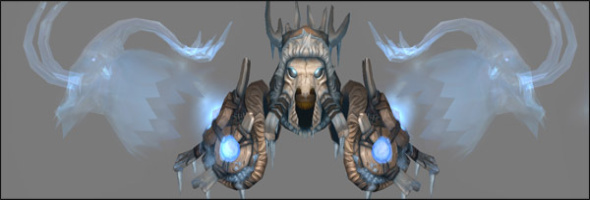
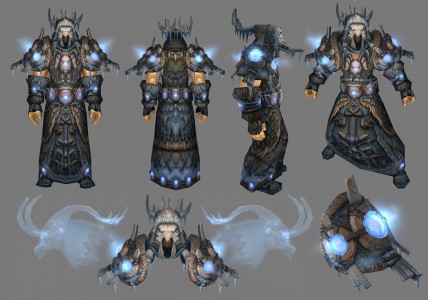
Now while I have been busy with that among several other projects, I have not been living under a rock. I did see the Shaman tier 10 models and I dare say that Blizzard put it up rather shortly after my Cardboard Samurai post because I think they realized the natives were restless 😉 Lets take a look at it in it’s full glory shall we?

huge-sh

This thing kicks allllllll kinds of tail in my opinion. Personally I think we won Tier 10. It’s stylish, the color scheme is awesome the placement of the ice is tasteful and well…lets be honest the shoulder effect is about as sweet as I’ve seen since Warlock Tier 6 bat wings. The only other armor set for tier 10 that comes close is the Warriors, but even that falls short in my opinion. Compare tier 10’s look to tier 9’s

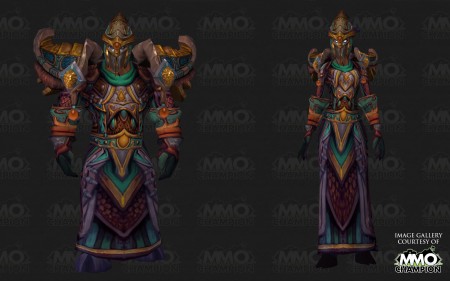
mmocwow-t9a_shaman1-450x281

Aside from the kilt, this set is identical to the hunters tier 9. It didn’t look very shamanistic, and to be honest it was pretty ugly. I wish I could hide my t9 or have a vanity set shown over it because it’s not that great. Tier 10 feels very shamanistic, lets not forget that Ner’zhul was a shaman before he became the lich king, so the tier 10 armor has this erie shamanistic feel to it. It has the icicles around it randomly for the elemental feel of water, and the bones are that of what appears to be a Shoveltusk. Stags, Talbuk and Shoveltusk have always been representations for the Spirit of the hunt or spirit of the wild for shaman, so it seems only fitting to have not only their bones but the spirtual image of them pushing outwards from the shoulders.

I’m impressed and honestly very very happy with it. I think this was blizzards way of saying “we’re sorry for tier 9 guys, here… look awesome” and I say to them. Thank you. I’m quite pleased with how tier 10 came out.

What about you guys? What do you think about the Shaman tier 10? Think it looks good, bad, meh?

until next time, happy healing

Sig

all images courtesy of MMO-Champion.com

Running a Raid: 10 Golden Rules (part 2)

RaidRules2

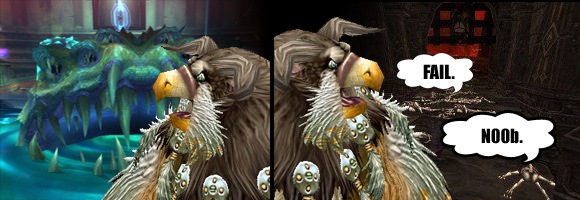
Last week we took a look at the first five of That Which Should Be Lore to raid leaders from all corners of the World… of Warcraft. Well, all right – it’s only advice from an oversized bird, but here’s to it being helpful or at least entertaining. Here are the other five rules for your perusal.

6: Talk to your raid when things go wrong. Things go wrong. Fact. If they do, take a deep breath; some of your raiders might not. Try to be patient – remember that players often don’t really get a fight until they’ve seen it in action, and anyone can make simple mistakes. Keep an eye on what’s happening in a fight to stay informed. Research addons you can use to monitor performance and stay quietly informed; not to throw blame around, which some raiders might do. Prevent that: it will obscure the real cause behind things going wrong and your raid group may acquire a mentality that splits it into “us/them”.

  • As soon as a wipe occurs I start talking to the raid about it. For example, we wiped a lot on Yogg Saron the first time we met him… her… it.. Whenever a wipe occurred I began with something that went well and was applicable to as many of the raiders as possible. For example, the brain room team working like a well oiled machine when inside and the outside team freeing people from constrictors.
  • I’d then state what seemed to be the problem for the attempt of cause of the wipe. Say for this attempt it was the brain room team needing to be a bit sharper getting out of the brain room so that they didn’t turn into frothing lunatics and try to kill the rest of the raid.
  • I’d go on to things we could improve without laying the blame at any one raider’s feet.
  • Last but not least, I’d ask if anyone has anything to add. If your raid has the right atmosphere people may well follow your lead and approach, and be supportive at best and constructively critical to each other at worst. This helps the raid build a joint safe environment.

7:  Deal with conflict. Conflict can occur between any raiders if the situation is right for it. It may be a single flare like two players conflicting over DPS. It may also be something more drawn-out – perhaps something that starts with one player sniping at another after a wipe, and then the argument gets dragged up and worsened as the run continues. There are a lot of reasons conflicts happen – the crux of it is to remember that people are just people, and will react to the situation and each other differently.

  • To some extent conflicts always involve you as the raid leader, even if you’re not directly involved. If you think a conflict is brewing up then deal with it in whispers to the players concerned before it hits the raid. If a conflict hits the raid and remains unresolved it will quickly get morale down and can lead to players making mistakes – it may lead to the group collapsing.
  • A lot of people don’t like dealing with conflict and that can include us raid leaders. Still, it’s important to sort it out before half the raid vote with their feet. Find a method of conflict resolution you’re comfortable with and one that supports the raid group. As an example, Herding Cats’ approach is to start dealing with conflict before it occurs. If you remember from last week I said that we tell people we expect them to be friendly and that griefing isn’t acceptable. Any troublemakers during the run are then dealt with either by a polite but firm comment in raid chat or a whispered warning from the raid leader or main assistant. Persistent or particularly offensive players are met with a firm hoof out of the instance portal.
  • I’ve found in the past that entire raid groups benefit from conflict resolution. People not involved in the conflict don’t feel that they may be caught in an awkward situation. People on the receiving end of grief feel supported. Sometimes the player causing trouble settles down and is grateful – a lot of the time they’re not troublemaking out of spite, they’re just not thinking.

8: Wear the sash well. Make sure you’re in control if you’re the raid leader. It’s fine if people have ideas they want to contribute to an encounter – being open to that is a sign that you are treating everyone equally, including yourself. But you may get raiders who ‘backseat raid lead’ for whatever reason. Perhaps they’re usually a raid leader and don’t realise they’re stepping on your toes. Perhaps it’s your first time in this encounter and though you’ve done your research, they’ve done it six times on seven alts and know better than you. Perhaps you’re a lowly DPS pretender to the raid leader crown and they’re a tank who believes that tanks rule over all by right.

TankTics

  • Having backseat raid leaders will confuse the group because everyone will listen to someone different. The consequence of a backseat raid leader yelling directions in TotC10? Two thirds of the group charging in on the arena fight on his orders to mete out justice to the Death Knight while leaving the enemy healers to heal to their hearts’ content before you’ve had time to readycheck.
  • There is a fine line between contributing and backseat raid leading. When I’ve come across this my usual method of dealing with it has been to note in chat that it’s important to have one raid leader so that people don’t get confused and a quick whisper to the backseat raid leader asking him to support you.
  • Also, if you’re delegating to one or several people – say you actually want Bob to help lead – then make it clear that the group should listen to decisions and whispers from you or Bob.

9: Encouragement. Oftentimes people will talk about something going wrong rather than something going right. This happens a lot in WoW too – particularly in any type of raid. Not to mention the fact that some players approach PUGs negatively; a tank might be convinced that an Ony25 run is  a loss before your merry band of adventurers gets to Dustwallow but will sigh and come along anyway. That same tank’s mindset might cause him to slip up on positioning Onyxia and see the unwary and dispirited melee DPSers take a trip into whelpland.

  • So, try to present the positives – but be genuine and don’t overdo it. Let the group know when you’re impressed with something. If something went well, rejoice. The key though is not to forget individual players. If you have time occasionally whispering players when they’ve done something well  – even if they’re doing other things wrong – is a nice way to let them know they’re appreciated. This is important: especially if they’re new to the encounter or your group – or both. It will build trust, teamwork and their own sense of achievement.
  • Crumbs, if they *are* doing something vitally wrong then you can address it with a brief chat. For example, think of an encounter with Lord Jaraxxus; “Just to let you know that you’re doing really well on the dispelling, nicely done. Now if you could also focus on running away when you have legion flames – that will take some of the strain off the healers.”

10: Breaks. Raid groups can be fraught with multiple players going AFK “for 2 min”. Before you know it there’s been an extended break for 20 minutes. Players will be bored and will have lost focus – some folks may leave, which leads to extra time spent finding replacements.

  • You can cut impromptu AFKs down by building in or planning breaks and letting people know they will happen. They can then plan to get a drink, make that vital phone call, fix their addons – whatever – during the planned break time. Whether or not you can announce breaks by the clock or whether it’s better to plan in half hourly blocks subject to how the run is going depends both on your group and the instance.
  • It’s also a good idea to consider breaks tactically. For example, if you’re repeatedly bouncing off of a boss then announcing a five minute break after the next attempt will let people know that soon they can clear their mind. I’ve found that it’s possible for people to come back refreshed and down the boss flawlessly after the break. Equally, a break after a successful fight may sometimes be a good idea to let players relish the victory, but more often than not it’s a very bad idea to waste the free morale boost from a boss kill.

Now all 10 ‘rules’ in the book of Mimetir are up, though there are probably a dozen more basics to talk about. As I and last week’s commentators keep saying, it’s all about individual style. A constant willingness to learn and adapt your style also helps. I think the most basic principle, the one that rules them all, is not to be a brick wall to your group.

What are your thoughts? Do you wholeheartedly agree or vehemently disagree with any of the 10? Do you have any golden rules you’d like to share on raid leading? How do you feel as a raider, not necessarily a raid leader, when reading this? Are you thinking about starting to raid lead?