Koralon the Flame Watcher: New VoA Boss

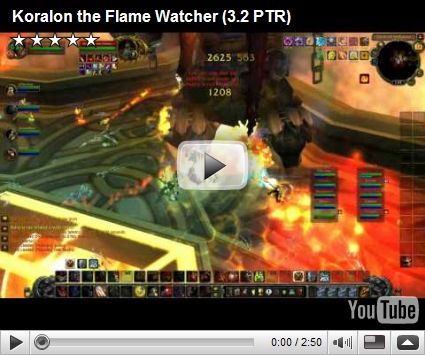
Here’s a first look at the new VoA boss.

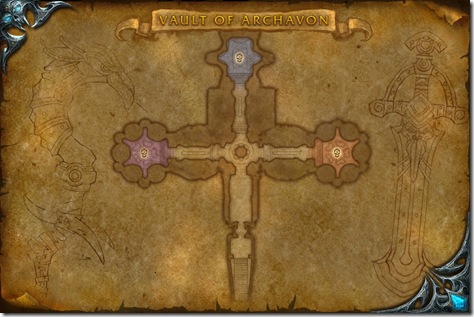
This what ultimately VoA is going to look like. We have an Earth boss, a Storm (air) boss, and now a Fire boss. I wonder where the Water boss is going to be situated.

Boss abilities

Not sure if there’s official names for them. That video was shot from the perspective of a Warrior (Arms I think).

First ability is the assorted flame patches that drop around. Stand out of the fires.

Second ability is the flame whirl like thing he does where he spins around and unleashes fire in every direction.

Expect this boss to drop tier 9 level loot.

1_24_06_09_9_21_23

I’m still downloading the 1.15 GB file right now for the PTR patch. I should be suiting up and ready to go within the next several hours.

Resto Shaman Tier 9 and More!

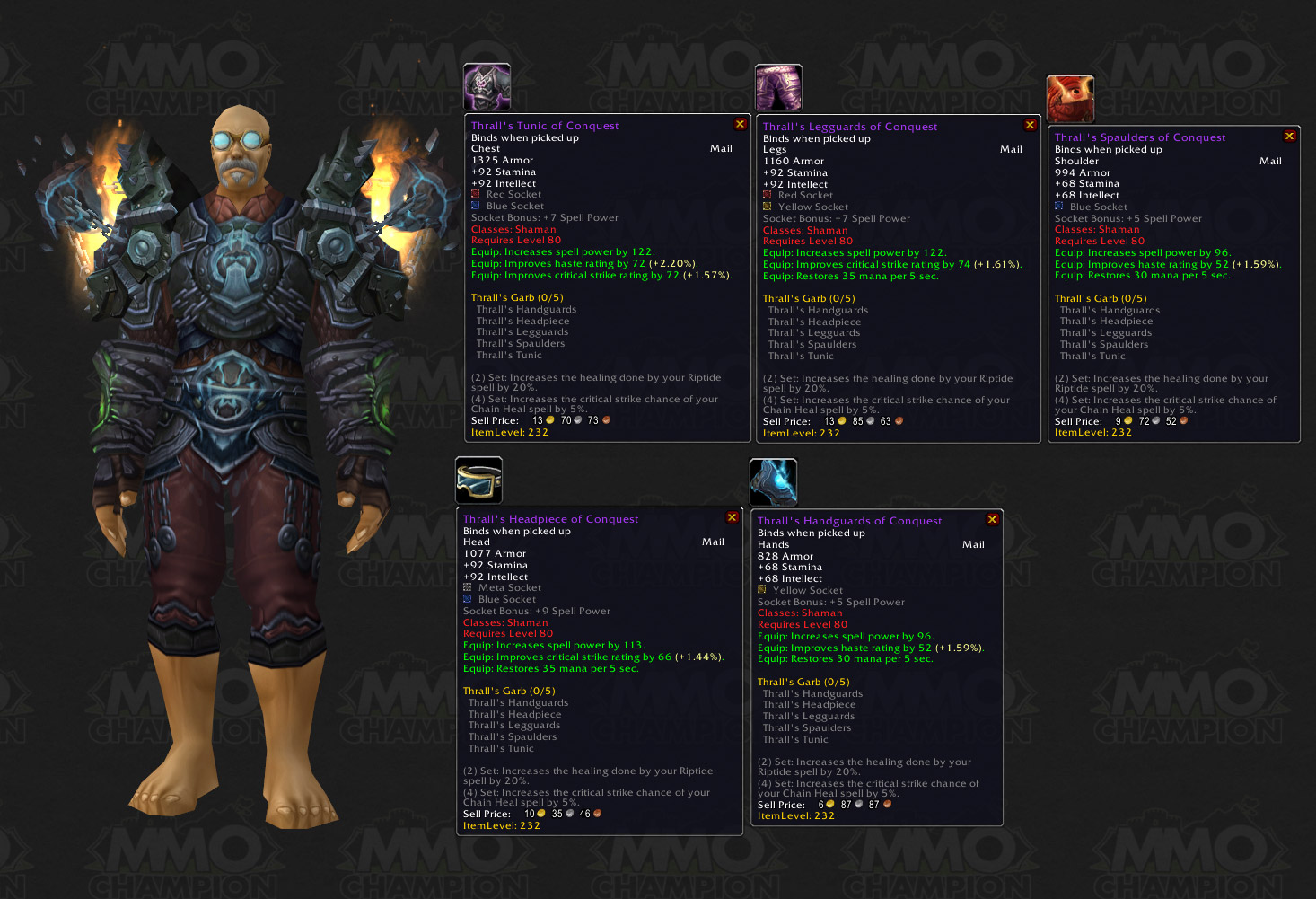
By now I’m sure you’ve all heard about the tier 9 sets that have been released. Unlike Tier 7 and 8, instead of having two different levels of gear, there are three levels.

Conquest (ilevel 232)

Triumph (ilevel 245)

Heroic Triumph (ilevel 258)

This is kind of nifty. It adds more opportunity for raiders of all levels to gain tier set pieces. There is no artwork for it yet, but you can click the link and check the stats. The big thing here is the set bonuses.

Instant cast
Increases the healing done by your Riptide spell by 20%.
Instant cast
Increases the critical strike chance of your Chain Heal spell by 5%.

These might not seem like a lot, but these are quite nice as it stands. Lets take a look at the 2 Piece. Riptide already seems to have received a little buff in it’s healing come the patch but lets use the value of the Rank 4 Riptide and according to the 3.2 talent sheet, the current rank 1 Riptide

The spell has two parts we’ll make the assumption that the set bonus affects both parts. The spell initially hits for 1604 to 1736, a 20% increase on that 1925 to 2083 on the front end. After the initial heal it places a heal over time for 1670. With the set bonus that HoT becomes 2004 over 15 seconds. While that might not seem like a lot consider a couple things. First it’s an instant heal and HoT for Shamans, never a bad thing. The new ranks for the spell haven’t been released yet (that I can find, if you see them please link them to me) so you can imagine those numbers will be higher. Secondly combine the 2 piece with Glyph of Riptide which increases the duration of the HoT by 6 seconds (or with these numbers should be another 800 healing if my math is right) and 2 piece Tier 8 , which lowers the CD of Riptide by a second and you have an instant heal that places a 21 second HoT on your target, and it only has a 5 second cool down. I can see that being extremely useful. Oh, and it still buffs chain heal on the target by 25%.
Let’s take a look at the 4 piece bonus now. Increasing the critical strike change of Chain Heal by 5% might not seem like a lot either, but you have to keep in mind a couple things. Before raid buffs I’m packing close to 27 % crit, maybe more depending on what pieces I am wearing. I suspect the vast majority of the Shaman Healing community falls between 25% and 30% before buffs (cursory glace at armory seems to support that theory) in a raid environment you can already get close to 40% crit. Adding another 5% to that is just insane, it will definitely increase our throughput quite a bit. It will also work hand in hand with changes to Improved Water Shield which now procs off of chain heal without consuming an orb. This will do wonders for our mana regeneration along with our healing throughput.

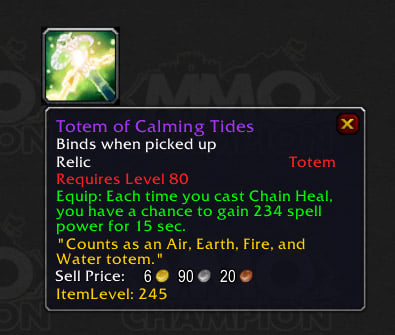
The newest item I’m probably most excited about though so far is not the Tier 9 set (while it is nice) but we have a new Totem. The Totem of Calming Tides is, quite simply put sexy. When you cast Chain Heal you have a chance to gain 234 spell power for 15 seconds. That is just nice any way you slice it. Combine that with the increased crit chance and the fact we’ll most likely be packing enough haste to have 2 second or sub 2 second chain heals and I suspect more often then not we’ll have the buff. There is no information on proc percentages yet, but it’s still very early in the PTR.  It should also be noted that this so far does not just affect your chain heal spell power, but your overall spellpower, meaning when it procs Earth Shield, Riptide, our various Healing Waves and even Healing Stream Totem will gain a benefit. Personally I can’t wait to get my grubby little Shaman fingers on this one.

Along with the Tier Sets we were provided information for Badge Goggles andBadge Shoulders. While they are pretty good I just find myself hard pressed to get excited about them. Maybe after the models are released for Horde / Alliance.

The new totem and the Tier set fits very nicely with the talent and spell changes for Shamans in the coming patch, you can read my initial thoughts on them Here.

For those who don’t remember here they are again.

  • Call of Air – Simultaneously places up to 4 totems specified in the Totem Bar. Can call different totems that Call of Fire or Call of Water.
  • Call of Water – Simultaneously places up to 4 totems specified in the Totem Bar. Can call different totems that Call of Fire.
  • Call of Fire – Simultaneously places up to 4 totems specified in the Totem Bar.
  • Totemic Call has been renamed to Call of Earth -     Returns your totems to the earth, giving you 25% of the mana required to cast each totem destroyed by Call of Earth.
  • Tidal Waves has been changed to -     When you cast Chain Heal or Riptide, you have a 100% chance to lower the cast time of your Healing Wave spell by 30% and increase the critical effect chance of your Lesser Healing Wave spell by 25%, until two such spells have been cast. In addition, your Healing Wave gains an additional 4/8/12/16/20% of your bonus healing effects and your Lesser Healing Wave gains an additional 2/4/6/8/10% of your bonus healing effects.
  • Nature’s Guardian now give you a 100% chance to increase your maximum health by 15% for 10 sec instead of 50% chance to heal for 10% of your total health. Cooldown increased from 8 second to 30 second.
  • Mana Tide Totem now has 10% of the caster’s health. (Up from 5 health)
  • Nature’s Swiftness now has a 2 min cooldown. (Down from 3 min)
  • Improved Water Shield no longer consumes a Water Shield Orb when you gain a critical effect from your spells, now also has a 10/20/30% chance to proc from Chain Heal.
  • Ancestral Healing now reduces your target’s physical damage taken by 3/7/10% instead of increasing its armor by 8/16/25%.

Looking at those and looking at the set bonus I’m definitely starting to get excited. I’ll report more on it after I get some time in on the PTR, Lodur is transferred over on the PvE server for the PTR and will be getting some play time tonight after my raid and tomorrow for sure. I’ll update this when I get some more information on how the talents are working and how it feels in a raid environment, particularly hard modes.

What do you guys think of the Tier set and the Relic? Are you going to transfer over onto the PTR and try the new talents out? Are you looking forward to hard mode as a Shaman healer?

Until next time, Happy Healing.

Sig

The Summertime Woes

summertime

Summertime and the livin is easy
Fish are jumpin and the cotton is fine
Oh your daddys rich and your ma is good lookin
So hush little baby, don’t you cry

-Gershwin

So the weather outside is becoming nice once again for many of us. With the nice weather comes what I like to refer to as the “Raider’s Lull” . What is the Raider’s Lull you ask? It’s that time of year where people start to take a break from the game and venture forth into the outside world for a while. For some guilds in Warcraft it’s not a big deal, they simply replenish from within and keep trudging through content while waiting for the other players return. For others it becomes an exercise in recruitment methods. I’m sure you’ve seen them on the realm forums, various websites and services like Twitter all asking for recruits and potential applicants to head over to their site. For some guilds it’s the beginning of their death throes.

The first category, the guilds that don’t feel the bite, tend to be the more progression oriented. They normally have several raiders waiting in the wings or rotating just for the reason of filling gaps due to holidays and such. These more often then not are also the top guilds on your server in those terms as well, normally one of those “server first” type guilds. If you find yourself in one of these guilds, then you probably haven’t seen the Raider’s Lull

The second category is more common, and I freely admit my own guild recently falls into this category this year. These tend to be not less progression oriented guilds, but ones that are more laid back in their approach to getting there. Attendance issues pop up in the summer when weather is nice and kids are out of school. It’s understandable and more often then not the guild just has to bide it’s time until the raiders return, utilizing other members of the guild who maybe don’t normally raid.

The third group is a bit trickier. Usually this is a guild that has had ongoing attendance issues year round, or has been subject to some form of drama. Sometimes more progression oriented guildies have just left for another guild or even their members are looking for a guild that fits their ideals better. The summer time seems to bring these to a head and they wind up splintering and finding new homes, some players even quit the game as a result.

Breaking the Depression!

So how does one from the second and third category keep going into the summer time?

Recruitment!

recruitment2

Oddly enough recruitment can solve both the second and third groups problems. I’ll use my guild as an example again. Summer time hit and we saw the loss of a handful of raiders, the problem was these were people integral to our raid and raid strategy on some accounts. We have veterans we can pull for raids when they are on, but since they are veterans and not raiders their schedules tend to be a bit more erratic and pinning them down can be difficult, but pulling from our friends and family in the guild we have been able to keep raiding fairly consistently with good results. They may not be hard mode ready, but they can still kick like a mule when they need to.

The raiders we lost were well geared and performed well. It left us with several holes to fill. Our officers proactively hit recruitment hard utilizing various methods. As a result we have had an influx of  very solid recruits. The recruits are from a guild of the third option above. Their guild was not a comfortable fit for them anymore, and they happened to see a post of mine saying we were looking for geared intelligent raiders. I talked to one of them for almost a month answering questions as best I could. They were from another server so a certain leap of faith was required though this app process as my guild requires our apps be on server for the trial periods and such. After much communication, enter four applicants. They are currently going through our application process, but they have already been making friends and feel like a good fit. Recruitment has kept us going strong and has helped us keep raiding, and it helped four very awesome people find a potential new home with new friends. So thank you Kaylestera, Trull, Andorel and Lysah for taking a leap of faith and putting in those apps.

For recruiting there are several different ways to go about it. For my guild we utilized internet services such as

Twitter,

Realm Forums,

Guild Website,

We also utilized Word of Mouth along the server, with friends from other guilds letting people know we were recruiting. Members of our guild spread word among their real life friends as well as their friends on server letting them know we were hiring so to speak. So far it’s been working out very well. Unpossible is still going strong and we’ll survive our Raider’s Lull.

So, is your guild facing the Raider’s Lull? If so, how are you compensating for it? What category does your guild fall into?

Until next time, Happy Healing.

Sig

Images courtesy of akmg.com and electrotestservies.co.uk

Symbiotic Altoholism

This is a guest post by Saunder, a Holy Paladin from Non-squishy Heals.

Before I start I guess I should say a bit about myself. I have 2 level 80 Holy/Ret dual-specced Pallys (instance as holy, solo as ret), a 73 hunter and a 58 druid. Well I have lots more, but they are the important ones.

Most of you will be familiar with the idea of Symbiotic relationships. One definition of such relationships is that it occurs where both organisms benefit. I see alts as exactly this sort of relationship.

The hunter was my original toon. I leveled him in the blissful ignorance that comes from not reading about game mechanics, and running instances in the totally blithe knowledge that the tank will *always* have aggro, and the healer will *always* keep you alive. After all, a hunter is DPS so all that matters is how much damage he or she can do, yes?

I then rolled a Pally, and enjoyed it. I liked healing and now my Pallys are unquestionably my mains … Can you have multiple ‘main’s? Anyway … And I found out some rather nasty truths. The first one was that Hunters who don’t manage their own aggro, even at the expense of their DPS are very very unpleasant group mates to have for healers at times. I have come to realise that my play as the hunter has been immeasurably improved by playing a healer. You may ask why – well, now I know that DPS isn’t everything. You need to find ways to put out the best DPS *without* pulling more threat than the tank and, if that isn’t enough, sometimes there is no better thing for the group and the run as a whole than for the DPS to fall on their sword and protect the healer, even at the expense of their own life and repair bill. It’s not what you signed up for, but it *is* the hard reality. Not only have these observations led to much improved play as the hunter, I hope that the number of pug members swearing at me behind my back has decreased markedly. I firmly believe that to be a really effective DPS, you need to play a healer, most likely to a high enough level to run some reasonable instances with pugs and learn some of the mistakes that will keep you on your main, and your group mates, alive and happy longer.

The second truth I found was that of healing priorities. In an instance, your first and foremost role as a healer is to stay alive. That may be a very selfish view, but seriously, how much healing can you do dead? The best tank and group in the world will need heals at some point (ok, with a couple of Blood DK’s or a hybrid class that can step in that may not be an absolute, but you know what I mean) and that means you the healer need to be alive and kicking so that you can provide those heals. (It’s also a pain in the behind to have to keep running back from a graveyard if you are the only one who can res but that is secondary). The next priority is the tank. Obviously anyone who is going to keep the attention of the instance denizens away from you and the rest of the group is a good person to look after. And, in case you hadn’t noticed, healers tend to be high up there on the threat table. Second on a threat table is a bad place to be if the first on the table dies, usually leading to the situation above where you can’t heal the rest of the group as you are dead!

So there it is, Healing Priorities in a nutshell. Now, now, now, before I hear all you DPS baying at the moon for my blood (do feral Druids in kitty form still bay? *grin*), I don’t mean that I don’t heal the DPS, far from it. I will heal anyone in a party or raid, players, pets, mind controlled mobs or whoever but I will heal them after I heal myself and the tank. In a perfect world no-one will die in an instance run, but, with the exceptions of DPS-races where the boss enrage-wipes, the death of a DPS is merely an inconvenience. The death of a tank or healer is often disastrous. DPS need to understand that there are times, and that is particularly true if they do something crazy, that death is inevitable. Live with it, and know that we your healers try to keep it to a minimum.

Then there is the very uncomfortable truth that there are players out there who just don’t seem to ‘get’ it. You can tell them that unloading the full barrage of their uber talents and abilities before the tank has established threat is a bad idea until you are blue in the face and they will not change their ways. Surprising how fast they learn when you let them die as a result of their actions. Explain to them the pain they are causing, then if they don’t learn, just practice tough love. They will, and the group as a whole will thank you for it in the long term.

So on the one hand, playing a healer alt really is a good thing for the DPS classes out there, and as a side effect, obviously, some percentage of you will find that you like healing, thus helping with the perpetual healer shortage. Excellent. I can live with that! :D On the other hand, it is just as valuable for a healing class to play the DPS role. Why you ask? As a healer, you need to know as much as possible that will make your runs more successful. After all, rightly or wrongly, the finger of blame is often pointed at the healer when there are problems. That means knowing the mistakes the other classes are likely to make. It can be a general knowledge such as the hunter example above, or it could be something much more specific. When that particular glow comes from the mage’s hands, for example, a LOT of AOE damage is about to happen, and that, in turn, leads to a LOT of threat. So have the big heal part way throughcasting so that if the mage *does* get aggro you might save them from being one-shotted. For those classes where you have emergency buttons, bubbling a mage in those sort of circumstance is not a bad idea. How cool is it to hear the anguished sounds that the clothies make on vent when they get aggro only to find they are still alive! You get to sit back and bask in the adulation of your peers. Ok, they mostly just grunt at you and expect it, but that’s the life of a healer

Really look at the benefits of the different instance roles. Playing a different role is a big way to get fresh enjoyment and experiences. It will keep it interesting at the very least, and you never know, you might actually learn something and make life easier for everyone around you.

For more great rants (and commentary), do visit Non-Squishy Heals and be sure to subscribe!

What Can Healing Meters Tell You?

meters
The conflict over healing meters is an old topic, on this blog, the WoW healing forums, the PlusHeal forums, and, for many of you, within your own guilds. While it’s widely accepted that meters are one of the best tools dps players can use to analyze their performance, the usefulness of meters when it comes to healing or tanking has always been in doubt. The official line from Ghostcrawler is that meters can’t tell healers very much about their own effectiveness. The following story is a tidbit taken from a forum topic on Shaman PvE healing. I first read it, however, in a repost on my own guild’s site. It seems that whenever the developers comment on healing meters, people take notice. Ghostcrawler says:

We were talking about healing this very fight [XT hardmode] just yesterday. One of the designers had an interesting experience. Their first Holy priest had much larger healing (total and effective) on the fight than their second Holy priest, so they asked the second priest to go Shadow. They kept wiping. They then swapped them, and made the star Holy priest go Shadow. The second Holy priest’s healing was much lower, but they won on the first try. The second priest just had better timing and cast the right spell at the right moment, even though his total and effective healing was lower overall. The moral of the story is meters are very useful, but like any tool, their ability to measure what happens in reality has limitations. In my experience, players put too much emphasis on them, especially for healing.

I have to say that GC’s Tale of Two Priests seems apocryphal to me. As my guild members pointed out in our website discussion, this is an odd situation that we can’t really imagine in any of our raids. It seems–to us anyway–that there’s not enough information here to judge what really happened. One of my guildies suggested that maybe the “star” Holy Priest was also really good at Shadow, and that seems pretty reasonable to me. However, what’s clear is that Ghostcrawler–who, let’s face it, has more information than you or I do–thinks people put too much emphasis on meters.

The truth of the matter is that healing meters CAN tell you a good number of things about a healer’s overall effectiveness. The trick is learning to read them with a critical eye. In the interest of full disclosure, I’ll tell you that I probably like and use healing meters more than most healing bloggers I read, and certainly more than Ghostcrawler. However, in my own guild, I’m usually in the anti-meters faction. Ironically, our guild’s biggest advocate for healing meters is not himself a healer. There’s no guarantee that a guild’s leadership will be healing-savvy, and the points in this article should help raiding healers enter into an intelligent discussion with even the most determined meter-maid of a raid leader.

In this article, I’m going to go over a few things that healing meters CAN and CANNOT reveal about your guild’s healers. I would never, for example, promote or dismiss a healer from my raiding corps based on meters alone. However, if I were evaluating a new healer, I would expect the different logs to be able to tell me a certain amount of things. At certain points, I’m going to be referring to the combat log parsers I’ve personally used, including WWS, WoW Meter Online, World of Logs, and of course, the ubiquitous Recount. Each of these programs displays the information differently, and some are more nuanced in their presentation than others.

What Meters Reveal

Who won the meter?
Did you win the meters last night? If you can answer this question, as a healer anyway, you don’t know how to read the meters. In the above screenshot from WoWMeter Online, it might look like Kaldora “beat” Mallet on the meters…until you notice that Mallet is a discipline priest and, as such, his primary ability doesn’t even show. Essentially, when you are looking at any combat log statistics in any form (even scrolling through the log itself), what you are doing is reconstructing the raid from perspectives other than your own. It’s a bit odd, like watching a home movie of yourself. Just like the camera’s lens, the log parser has a limited view of your actions. It collects statistics, and these tend to be fairly accurate, but you have to do the evaluation yourself. I read a combat log parse critically, and the following are the questions that the statistics can help me answer.

1. What were the healing assignments?
As a rule, tank healers place lower on the meter than raid healers. That’s just how it is–unlike dps, who can do infinite damage, a healer can only put out the numbers in response to damage. The more targets, the higher the ceiling. When I look at a breakdown for a particular fight, I can reconstruct the healing leader’s instructions to the raid pretty easily. The “Breakdown” section of WWS or “Who Healed Whom” section of WoWmeteronline will tell you for certain where people spent their time. However, for the most part I can reconstruct who did what just based on percentage of healing done and spell choice. When I have a new recruit in the raid, I use the meters to check if she’s been following instructions.

2. What is a player’s rotation?
If you’re a longtime healer, you might think that you don’t have a rotation. You just do what seems “natural,” right? Healing might seem like a mysterious force that arises out of the aether, but in fact, every healer has a rotation, either explicit or implicit. It only seems that there’s no rotation because you’re not mashing 1-2-3-3-3-3-3-4-4-4-4-4 like a Moonkin would (and let me tell you, the rare times Matticus lets me play laser chicken I need serious help from Squawk and Awe to get the 3’s and 4’s at the right time). Healer rotations are not necessarily set; rather, they are a series of if-then statements. If X kind of damage occurs, the healer casts spell Y. Some healers have a more explicit rotation than others. Druids are the most like dps in that our healing spells set up combos. 3X Lifebloom is a component of a rotation, as is a HoT setup for Nourish. And that 6-second cooldown for Wild Growth or Circle of Healing? That little piece of timing contributes to the development of a rotation for Resto Druids and Holy Priests. I don’t know about the rest of you, but whenever I’m raid healing, I’m watching my Wild Growth cooldown like a hawk. I know the number of casts I can perform before it’s up again. Every single class has something they do pre-emptively. For Healadins, it’s Bacon of Light and Holy Shield. For the Resto Shaman, it’s Riptide.

After long practice, these routines become automatic. The muscles are quite literally faster than the brain, and before you know it, you’ve hit Rejuv-Rejuv-Rejuv-Swiftmend-Wild Growth without once stopping to think about it. My favorite section of the log parsers are the spell breakdowns. On WoWMeterOnline, I particularly appreciate the pie chart of my abilities. I love the fact that I can compare two sets of statistics–the proportion of spells I actually cast (the pie), versus how much effective healing those spells accomplished (the column). This feature lets me amend my rotation. If I’m casting something too much and not getting enough effective healing out of it, I can alter that pattern. I can also compare my spell choice and cast ratios to other Druids. I’m never the best one out there, and I know it. If I think someone put in a stellar performance on a fight, I try to learn from it. If I see a Druid do particularly well in a fight using 15% Nourish, I’ll make a conscious effort to use it the next time.

The following image is the breakdown of my own abilities during a Mimiron fight. From this chart, you can reconstruct my rotation. It appears to be very heavy on Rejuv and Wild Growth, probably during the raid healing portions of the fight, with Lifebloom and Nourish used much less (probably mostly on tank targets in P1 and P4).
spell choice

Here is the WoWMeterOnline pie chart for a different Mimiron fight. Even pre-4pc bonus, I’m still getting more than my money’s worth for Rejuvenation. It accounted for 23% of my casts but did 38% of my healing. Nourish, on the other hand, is a relative loser, being a fairly large portion of my casts but a fairly small portion of my healing done. To some extent, this is just the nature of the two spells, but on this particular fight, HoTs are king. Rejuv doesn’t look nearly as good on a fight with less predictable AoE damage.
healing pie chart

3. Did something go terribly wrong?
If you’re accustomed to reading log parses for your guild, you can start to separate the wipes from the successes. Particularly if a wipe was blamed on healing failure, I urge you to go through the parse for that attempt. For this purpose, I find the death log and the Who Healed Whom? sections to be most useful. If you have a healer who repeatedly dies to the same (avoidable) boss ability, that information may help you improve your healing corps. I find, however, that most healing fails have less to do with healers standing in the fire than with healers deviating from their responsibilities. If you lost a tank on an attempt, go look at what your tank healers were doing. In particular, a little statistic called the Focus is helpful for this. If a tank healer has a high focus, that means they are healing randomly in the raid–i.e. diverting attention from their assigned tank. There are many reasons healers do this, but I’ll tell you, most of them have to do with a desire to look better on the meters. I’ve done it myself–looked away from the tank for one moment because I thought I could–and boy does it feel bad afterwards when that little innocent raid heal causes a wipe.

4. Which healer–allowing for class, spec, and assignment–contributed the most on a particular fight?
This is the moment where you really get to compare. You won’t necessarily be able to do this on every fight. Healing corps tend to shift about a bit, as healer turnover is always pretty high. However, on the occasions where you have two holy priests, you can compare them if and only if they were given the same assignment. If you are a healing lead, and you have a new recruit, try to assign them to the same thing as one of your veterans. This is most useful if you can pair them with the same class, but if that isn’t possible, try to match their role as closely as possible. You won’t get anywhere comparing the numbers of a Resto Shaman and a Resto Druid, even if you assign them both to heal the tank. However, if you assign your Resto Shaman to tank healing, you can compare his or her numbers to a Holy Paladin. It might not tell you much, but at least you can see which one kept a tighter focus on their tank or did more healing on that one target. If you do get the magical situation where you can compare raid-healing Resto Druid to raid-healing Resto Druid, you can actually pick a winner. Try to use your knowledge for good and not evil. If you have a new recruit who has some learning to do, encourage them to adopt spell choices more like your veteran. I do urge you to have several parses before you make your recruit change things. What the parses can’t do on their own is tell WHY one player “won” the meters.

5. How much of a role did heal-sniping play in a particular fight?
Ah, sniping. Whenever someone “loses” the meters and others make a big deal about it, there will be talk of sniping. The rather ugly word “sniping” indicates the practice of sneaking around on one’s healing assignment by spot healing other players. To some extent, sniping is something that can’t be avoided. If players are assigned to raid healing, those assignments have to be loose in order to let healers react to the actual damage that goes on in the fight. Even with mods, it’s sometimes hard to tell which raid members are about to receive a needed heal. As a healing leader, just understand how raid heal sniping works against certain classes. Circle of Healing and Wild Growth, due to their “smart” nature, can’t be kept to a neat assignment. These spells will “steal” some heals from your Resto Shamans. If you know that, you know to calm your shamans down when they’re worried. It’s just something that happens–so don’t demote your Shamans or overly praise your Druids. That’s just how the mechanics work together. Believe me, you need every competent healer you have–a raid is not a game of Survivor. If you want to minimize raid heal sniping, I suggest giving your healers proximity-based assignments. Our Mimiron strategy is a good example–we assign healers to quadrants, and as we’re spread out in a ring for P1, P2, and P4 of the fight, healers can’t reach across the room to snipe from their fellows. However, when you’re all clumped up, snipe happens.

Raid heal sniping tends not to affect the outcome of a fight, but the same cannot be said of sniping while tank healing. Sometimes tank healers need a little support. While a HoT or two from a raid healer on a tank is technically sniping, it’s usually helpful. After all, if the tank dies, you’re done, and extra insurance is not a bad thing. However, when your tank healers sneak heals onto the raid, it’s not always so helpful and it sometimes gets the tank killed. However, in some sense we are set up to do just this. I know that in particular, Holy Priests and Resto Druids can (and sometimes should) sneak a few Circles of Healing or Wild Growths on the raid while they’re tank healing. The trick is to have a realistic sense of how often you can turn away from your focus and for how long. I know the couple of times in my healing career I’ve caused a tank death because I’ve been sniping have been moments of intense shame and regret. If you have weird tank deaths in your raid, go check out healers’ focuses. That should tell you if sniping is the cause.

6. How do the healing classes differ from each other?
Whenever I look through a log parse, I’m struck by just how different the four healing classes are. I especially like to look at players’ spell choice. Some, like Holy Pallies, will show a lot of casts of the same thing, while others, like Holy Priests, will show a variety of abilities. This helps me reconstruct what healing was like in a particular raid. When you’re reading those meters, particularly a simple meter like Recount, you should know that “winning” those meters is linked to class and spec. If I’m looking at Recount, especially one that hasn’t been reset for a certain fight but rather has been running all night, I’m probably going to see either a Resto Druid or Holy Priest on top. That’s just what happens–it doesn’t mean too much. The meter is not a perfect measure. It sees a limited amount of information. It can’t tell you, for example, just how important your Pally’s tank heals were. All it can tell you was that he put out less raw healing than your raid healers. Even on the same assignment, your Resto Shamans, Holy Pallies (unless you have no Ret Pally and your Healadin gets to cast Judgment of Light), and Disc Priests will almost always be lower down. This is just how our spells work together, and it doesn’t make Pallies or Shamans bad. Also, if your raid is melee heavy, you might sometimes see the Ret Pally sneak up the meter with just Judgment of Light. However, this doesn’t mean that you should make your Holy Pally go Ret because Ret’s healing is “better.” Believe me when I say that Judgment of Light alone won’t heal your tank.

Why Do Some Players Place Higher than Others on the Meter?

Even when class, spec, and assignment are the same, players’ numbers will vary. Many people would claim that “skill” determines placement, but it’s only part of the truth. That sort of answer contradicts GC’s anecdote and gives healers a sense that they can’t improve, no matter what they do. However, there are usually resolvable issues that determine effective healing. It’s not all reaction time or “innate” gaming ability! As a 30-year old woman who didn’t grow up playing video games, I wouldn’t stand a chance if it weren’t possible to learn better healing techniques. However, I find myself on the top of the meters from time to time (and also…on the bottom). This wouldn’t happen if it weren’t possible to change my performance through effort.

As a healing lead, I’ve read a lot of meters. In my mind, the following are the most common reasons for meter differences between players.

1. Casting speed. By “casting speed,” I mean the rate at which the player queues up a new spell once the old one casts. This is the magic of reaction time. It’s hard to learn, but faster casting is supported by Quartz, readable raid frames, a faster machine, gear (especially haste), talents, and little things like a Tuskarr’s Vitality enchant to boots. It seems silly but yes, faster running almost always means more time to cast.
2. Talent choices. Sometimes there are many correct builds, but there is usually one best one for certain raid functions. The “best” build can depend on what the person’s role in your raid is. If your recruit will primarily be a raid healer, she might want to adapt her talents to reflect that.
3. Spell choice. What you cast is just as important as how often. There’s no “right” answer, but there are better and worse choices. A heavy use of Nourish with no HoT support is an example of a poor choice. To make intelligent choices, read your blogs and Elitist Jerks and try out different things in raids. If you’re a healing lead trying to diagnose problems, try to find an “ideal” spell cast ratio to suggest to the healer in question from a reliable source. Usually, finding an “expert” in the class to talk to is quickest and easiest. When in doubt, email a blogger! You might just get a whole post in response.
4. Gear, gear, GEAR. I can’t overemphasize what a difference equipment makes. Sure, there are prodigies of healing out there that can outheal me in their Naxx gear. Don’t expect your recruits to be among these magical beings. Amazing reaction time is rare, and it can make up for gear deficits. However, for the rest of us, properly maintained equipment with the right stats, the right gems, and the right enchants is one of the major things we rely on to put in a good performance.

Wrong Ways to Use the Meters

If you’re in charge of a guild or healing corps, please do not indulge in the following meter-related Healing Destructions.

1. Looking exclusively at total healing done for the whole night
I hate it when people post their Recount for a four hour raid. Every fight is different, and many players respec to different roles throughout the night. Moreover, assignments differ from fight to fight. If you’re number 1, try to restrain the need to pat yourself on the back. If you’re number 7, you don’t really need that box of tissues.

2. Looking exclusively at HPS
HPS graph

HPS varies wildly by class, assignment, and fight. After all, you need damage to happen before you can heal. Here is a World of Logs chart showing my guild’s healers’ HPS for a whole night. What useful thing can you glean from that? Um, overall HPS is higher when heroism is cast? Big surprise there. If you’re in charge, don’t make your healers paranoid about HPS. They’ll be afraid to CC during trash, and they’ll snipe more during bosses.

3. Comparing apples to oranges
If you’re going to pick “winners” on the meters, make sure you’re looking at the same thing. The values for class, spec, and assignment need to match. Also, be really careful if you’re comparing your guild’s parse to another guild’s. You don’t know how they do things or how good they are. Judging your healers by an arbitrary external standard isn’t necessarily meaningful. For an example of this type, before we killed Vezax, our raid leader was outraged at the healers because we needed Saronite Vapors to stay in mana. He was looking at a parse where almost no one in the raid took damage and where healers used no vapors. It took me about ten minutes of staring at the report of a “better” guild with “better” healers before I realized that all these (failed) attempts were tries at HARD MODE. You have to walk before you can run, people–comparing your guild to the “best” guilds in the world is the Path of Anguish. The reports reconstruct the raid, but they are at best a distorted mirror. If you’re going to look outside the guild for comparisons, try to find a guild that’s similar to yours that’s working on the same goals.

4. Hiring and firing based on the meters
Everyone wants something concrete to rely on when they have to make a tough decision. Just don’t succumb to this pressure. If you have a borderline healer, watch her DURING the raid. I sometimes keep new healers as my focus so I can see what they’re doing. Give your newbie tough assignments and see if people die. These things will be more meaningful than saying: “You’re number 6 on Recount, so you’re out.”

5. Encouraging meter-based competition among your healers
The more the leadership emphasizes meters, the more your healers will respond. No one wants to be voted off the island. Instead of becoming better players, your healers will start ignoring their assignments, sniping, and whining. You really do not want this. Your healers are supposed to be a team.

Conclusions

Yes, healing meters can be useful. If you have access to log parses, you can certainly learn from them. As an individual, you may be able to tweak your performance. However, naive uses of the healing meters can cause mischief and pain. Reading a meter intelligently is a difficult skill to learn, and if you’re in a position of power, it would be in the best interest of your guild if you interpreted the meters as thoughtfully as possible. There’s no magic stat that you can read to tell if someone is good or not.
Sydsignature