Signs of an At-Risk Trial Raider and How to Address Them

I know firsthand how exciting and challenging (and annoying) recruiting raiders for your team can be. Every new player that comes in brings potential, but not every trial is going to be able to integrate into the team. Sure they’ve passed the initial sniff test they’ve answered the right questions, but now those players have to live up to those expectations that have been set. Recognizing when a recruit is at risk of failing their trial period and knowing how to address that situation is super important for maintaining a strong, progressed raid team.

Some of the biggest mistakes I’ve made when I was a GM (or as an officer) is not doing anything about the new trials that I felt weren’t fit, but I had to keep them around because the raid team as a whole didn’t have enough players to help go through a raid night. This would lead to feelings of resentment from more senior members of the team because they felt lacklustre trials weren’t really contributing to the progression or, worse, actively hampering any farm clears and slowing us down. If I could do it again, I would be more aggressive in identifying and making a more concerted effort to look for ways to help with improvement or at least open up communication with them.

Today, I want to explore some of the signs that a recruit may be struggling and offer up some pointers for addressing at-risk trial players.

Recognizing the Signs

Really, the first step that has to happen is actually identifying the member who is at risk of failing their trial or losing interest. These are some of the common indicators to watch for:

1. Inconsistent Attendance

If they don’t show up without saying anything, that’s usually a pretty good sign. A trial member who misses raids without prior notice or valid reasons might be struggling with commitment levels and realizing they can’t actually sustain the schedule they were hoping for. Consistency is key in a raiding guild (especially a CE one like ours), and frequent absences can disrupt the team’s progress and cohesion. We usually cut after 2 non-appearances and with no messaging from the player.

2. Performance Issues

While it’s true that everyone has an off night, consistent performance issues are another big sign. This includes not following mechanics, uncharacteristically low output (DPS or healing), and a failure to learn from mistakes. If a trial member repeatedly struggles despite feedback and guidance, it might just be a lack of effort or understanding. This is players not making that hustle to get to the stack point with everyone else, or getting their own debuff out of the raid before it detonates. It could also be someone resisting being a team player and not selecting talents or loading in a build that’s simply not ideal for the encounter. Going multi-target to help clear out ads when single target is what’s requested doesn’t help the raid get through those damage checkpoints.

3. Failure to Complete Required Mythic+ Dungeons

Mythic+ dungeons are absolutely important for character progression and meeting raid standards. At DJ’s, once we start extending raids, these are going to be the only sources of upgrades that players will be able to get (especially from their vaults). A trial member who neglects to complete the required key dungeons as outlined by the guild is going to be at risk of falling behind. Not participating is going to stall both their individual progress and the guild’s overall performance. It also demonstrates a lack of interest (in the game or the raid). We’re a CE guild, and we’re mandated to run at least 4 high keys a week. That’s not an impossible request, and it’s balanced around the expectation that players have other obligations (families, careers, hobbies, walking their pandas, etc).

4. Lack of Engagement

By itself, this isn’t a significant clue. A trial member who is not engaged in guild activities beyond raids might be losing interest. There should be some level of participation in guild chat, forums, or Discord discussions. Just being involved and engaging often builds a good impression of a member’s commitment and enthusiasm for the guild. At the same time, some players just don’t have that kind of social battery and shouldn’t be expected to be “on” all the time.

5. Lack of Communication

Effective communication is essential in a raiding guild. A trial member who rarely communicates with raid leaders or fails to respond to direct messages and discussions concerning them can be problematic. This might honestly mean a poor fit within the raid dynamic. We’ll try to reach out to new players from time to time to check in with them, and sometimes it isn’t really reciprocated.

6. Negative Attitude

Yeah, this one’s a biggie. Any trial member exhibiting a negative attitude or causing drama within the team is a problem and warrants a fast response. This might include being overly critical of someone else on the team, resistant to feedback from another player, creating conflict, or just being crazy defensive for no reason. There’s a right time and a right place for everything, including raid feedback.

7. Slow Improvement

While everyone learns at different paces, a trial member who shows little to no improvement over time, despite coaching and feedback, may not be a good fit. We are a CE guild, and our expectations are that players learn and adapt not just to their own mistakes but those of others. Progression raiding requires adaptability and growth. Lacking either of those isn’t going to lead to a solid finish.

Handling an At-Risk Trial Member

Have you figured out if someone is struggling? Next step is to figure out exactly how to handle it. You want to find ways to help them out but you also need to recognize when to cut your losses and let the player go if they’re not playing up to the level they need to.

1. Open Communication

Start an honest conversation with the player. Talk about some of the observed issues and provide specific examples. If you can use log replays or Warcraft Recorder clips to help demonstrate it, that can bolster your case. Work on your tone and make sure it’s constructive, focusing on their potential for improvement rather than just pointing out flaws (or everything that’s wrong with them). This can help the player understand the areas where they have to get better.

2. Provide Constructive Feedback

Give them feedback and actionable steps for improvement. Whether it’s specific mechanics they need to focus on (like less deaths to a key mechanic), DPS rotations, or positioning, clear guidance can help them know exactly what is expected. Give them resources like guides or videos to help their learning. Pair them up with someone in raid of a similar (or identical) class that they can learn from.

3. Set Clear Expectations

Reinforce and reiterate the expectations regarding performance, attendance, and behaviour. Make sure the trial member understands what is required to pass the trial. If you’re able to set clear, measurable goals, it’ll help both parties track progress.

4. Offer Support and Mentorship

Assign a mentor or buddy from the team to support the trial member. This can provide a more personalized approach to their improvement and help them feel more integrated into the guild. Regular check-ins with the mentor can offer ongoing guidance and encouragement. In DJs, we do our best to assign every new trial player a buddy (or a mentor) that’ll check in on them and help show them the ropes. Things like where to find the roster for the week, point the way where required WeakAuras are and answer any questions they might have.

They’re basically a Pokemon for the veteran raider.

5. Evaluate Progress

Monitor and assess the trial member’s progress over a set period. Are they showing improvement in the areas discussed? Are they more engaged and consistent? Regular evaluations can help determine if they are on the right track. Keep the feedback going as well. We have private Discord channels for each trial player where everyone on the team can provide observations (both positive and negative) about them along with how interactions have been.

6. Make a Decision

If, despite all efforts, the trial member is not meeting expectations, it’s time to consider letting them go. Approach this decision with empathy and professionalism. Thank them for their time and effort, and provide honest feedback on why they didn’t pass the trial. It’s important to maintain a positive and respectful atmosphere, even during difficult decisions. Sometimes a no means a not yet, and the player just needs to develop and gain more raid experience, whether it’s in another raid team that’s catered towards their skill level to allow them time to grow. After all, not every raid team is right for every player.

At-risk trial members in a raid guild require a careful balance of support and evaluation. Recognizing the signs early, providing constructive feedback, and offering mentorship can help struggling recruits improve and integrate into the team. However, knowing when to cut losses and let a player go is equally important for maintaining a strong, cohesive raid team. By handling these situations with transparency and empathy, you can ensure the long-term success and harmony of your guild.
Anxiety in Tanking and Healing Mythic Dungeons

Happy Wednesday and I hope you all had productive vaults this week! My Priest has gone dark and heavy on Shadow and DPS gear for the first week (up to 503 ilvl now). I was able to 2 chest a +10 with some guildies and stocked up some 8s. As a raid team, we completely cleared out normal and heroic before finishing out with 3 bosses in Mythic (Terros defeated). This week, we’ll be revisiting Aberrus.

I have a story here about a recent tank applicant to Death Jesters. On paper, the player looked like a fit. Their logs were on target, the defensive usage lined up, and it didn’t seem like there were many mechanical issues until I came across the below (Paraphrased):

“I’ve always found Mythic Plus content challenging and it tends to make me quite anxious, as it’s not my main focus in the game. My primary objective for this fated tier is to improve in this area. While this issue hasn’t impacted my performance in raid progression—I make sure not to be the weak link—it has caused some tension in previous guilds. I’m actively working to overcome this, though I expect it will take a bit of time. Fortunately, the fated tier presents a good opportunity for this.”

This admission does highlight a common feeling among players, especially tanks and healers, in the opening weeks of a new tier. Heck, this level of anxiety is even more pronounced during patches that introduce new dungeon content, where players have to learn new routes and strategies for handling enemies (and whatever abilities that might wipe the party). While this tier is already familiar to many of us with revisiting previous dungeons, the challenge of re-learning still looms, although that’s been mitigated by the various nerfs and tuning changes (Season 1 Ruby Life Pools was a nightmare).

However, avoiding Mythic Plus dungeons in the early stages is unacceptable at the Cutting Edge (CE) Progression or even a mid-level mythic raiding guild. Tanks are expected to step into these keys from the get-go. This early dungeon running is crucial not only for personal gearing but also for the success of the entire team. In guilds like ours, the majority of loot is allocated to favour DPS players, meaning that tanks and healers have to obtain upgrades predominantly from dungeons to supplement the raid.

As a tank within a raid team, one assumes the role akin to Atlas—a Titan doomed to bear the weight of the world on his shoulders. Like Atlas, tanks have that responsibility and must be both resilient and proactive in ensuring that all team members complete their keys with minimal reliance on outside players (pugging). Some players may have friends or other communities they can tap into, but others might be reluctant or unable to do so, requiring help from guild tanks and guild groups to step in and help with a smoother key experience.

With us, our tank expectations are clear — Step into mythic raid content feasibly early while simultaneously supporting the team’s collective needs. A tank that just logs in to update their gear and achieve our dungeon minimums before disappearing just barely meets the guild’s standards. Tanks are just such a bottleneck role at the start. We have a few healers and other DPS that are diversifying and collecting tank pieces to help address that and add more variability to schedules (and their goal isn’t to push high, but to get to a point where +8’s are reasonably comfortable). The role demands extensive involvement, a commitment to team progression, and an unyielding dedication to overcoming personal and collective challenges. I can certainly understand and sympathize the level of anxiety for pushing keys beyond the 10 (or even the 8 range) early on. I feel the same way. I did not feel confident at all healing anything past 8, that’s why I decided to give Shadow a go and get healing gear that way to help be available for raid needs.

Symptoms and Addressing Tank or Healer Anxiety

Anxiety experienced by tanks and healers can come about in different ways. This includes hesitation to join groups, fear of criticism, performance stress, and making decisions under pressure. This anxiety not only diminishes personal enjoyment but can also impact team dynamics and success. Tanks are also the ones dictating the pace of the dungeon (since they’re the ones tackling pulls). Is it time for a big monster pull? Go slower, and steadier at 1 or 2 pulls at a time? Are there DPS cooldowns up and available?

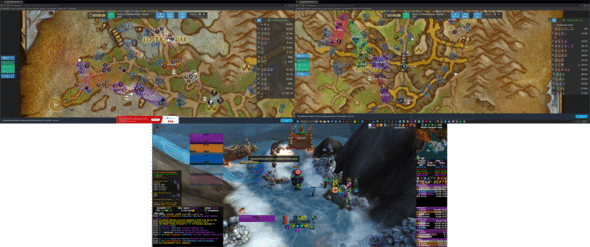
Our tank takes preparation to a bit of an extreme with this multi-monitor setup

Addressing these issues would take multiple approaches (and this list isn’t exhaustive either):

  • Education and Preparation: Knowledge of dungeon layouts, boss mechanics, and optimal strategies can ease some of the uncertainties that fuel anxiety.
  • Communication: Talking it out with the party can foster a supportive environment where fears can be shared and addressed collectively. Before big pulls, I’ll try to remind the team of key interrupts or things that can smoke the party if left unchecked. Tanks can call for personals or any extra externals (“Gotta kite, drop an Earthbind!”).
  • Incremental Progression: Slowly increasing the difficulty of dungeons can help build confidence in a controlled and manageable manner (I started from 4s and worked my way up).

Lastly, it also helps to play with people you know and trust who are familiar with each other.

If the root causes of anxiety can be addressed, raid teams can ensure that all members — regardless of their role — feel both competent and confident in their abilities to face the challenges of Mythic+ dungeons. It helps ensure that the game remains a fun and rewarding experience for everyone involved. The best step might be to join a more relaxed, less focused raid team to start where the pressure of grinding all those keys isn’t a factor. A competitive CE raid team isn’t the best environment to help properly support a player like that from the start. It’s not an easy journey, but it’s not impossible to work through and help control.

Anyway, back to Aberrus this week! If you’re looking for a raid team for Season 4 and the next expansion, come check us out! We’re looking for a Mistweaver Monk, assorted range DPS, and another tank!

How to Run Raid Orientation

Welcome to the new tier, everybody! We’re starting to kick off our raid this week. This is a great time to run raid orientation for the raid group, especially if you have many new players or if the raid team was on a break leading up to this point. For us it was mandatory because over half the team was new stemming from some major turnover. In this case, boss GM set up a preliminary officer meeting to go over the agenda for orientation and what to cover. I’ll dive into that one in a bit. Ultimately, he made some adjustments to an existing slidedeck that was created by one of the other raid teams in our community and co-opted some of those elements. I don’t really agree with some of the design choices, but I bit my tongue on that one.

If you want to watch DJ’s raid orientation, our GM did stream it, and you can find it here: https://www.twitch.tv/videos/1975224736?t=00h16m06s

What is Raid Orientation?

It’s exactly what it sounds like. You can liken it to your experiences when attending school for the first time.

Raid orientation is a crucial process where members of a guild come together to discuss, plan, and prepare for the challenges that lie ahead in a new raid tier. It’s the foundation upon which a successful raiding experience is built. This is where new members get to know each other, understand the guild’s strategies, and set their expectations with the goals.

This can be hosted in Discord and having your GM share their screen. They could also stream it and have it saved for anyone that missed out on it.

Benefits of Raid Orientation

But why?

  • Enhances Team Cohesion: It brings players together, fostering a sense of community and teamwork. For a bonus, you can add some icebreaker games at the end.
  • Aligns Goals: This helps to ensure that everyone is on the same page regarding the guild’s objectives.
  • Preparation: Provides an opportunity to discuss strategies and requirements, reducing confusion during actual raids. We’d rather get this done now or during the week before we set foot into the instance.
  • Resource Management: This helps in efficiently setting aside resources like consumables and loot. It also covers where players can find resources like assignments and strategy on Discord. In our case, we hold tier tokens until the end of the night to see what we have before distributing it all.

What Does Orientation Typically Include?

Player Expectations

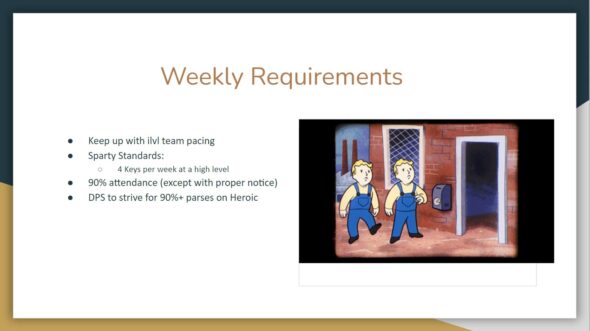
This segment focuses on what the guild expects from each player. It includes commitment levels, understanding of class roles, our community code of conduct, and basic raiding etiquette. We expect our players to complete 4 keys weekly. They don’t need to be 20s, but if they can eventually strive to hit 16s to 18s consistently within the first few weeks, it’ll set our team up for success. This also means how to handle attendance issues and who their raid mentors are. Basically, the GM is covering policy.

Raid Expectations

Here, we delve into the specifics of the raid content. This covers some strategies, boss mechanics, and the roles and responsibilities of each raid member. This means showing up on time. This means having the required WeakAuras installed and addons updated. It also means knowing their role and how to respond to mechanics in encounters while surviving. This could be its own night, though as we plan to have a film review on a different day before our raid night where we go over every encounter.

Consumables Expectations

Raiders need to come prepared with the necessary consumables. This part of the orientation covers the types of consumables required and how they contribute to the raid’s success, especially with the new health potions and other augments. Speaking of augments, there’s also the new reusable rune. Depending on your guild’s focus, that might be worth mentioning.

Loot Council

A key part of raiding is the distribution of loot. This section explains how the loot council operates and guides members on setting up their loot wish lists to make the process effective. We’ve also taken the liberty of requesting volunteers for the loot council. This is a call for members who wish to contribute more directly to the guild’s decision-making process with the resources and sims we have in place.

Goals and Pacing for the Tier from a Progression Standpoint

Setting realistic and achievable goals for the raid tier is critical. This includes discussing the pacing of the raid progression and what the guild aims to achieve each week. Even though we finished US 300 in Aberrus, we’re aiming for the US 400 mark this time at a slower pace. Think of this piece like setting the road map for the tier, including when raid extensions would begin.

Icebreakers

Think of some fun games you can play especially to help get newer members accustomed to the team. Sometimes we’d ask icebreaker questions but tell our players to type their answers in chat, but only press enter after a countdown hits 0.

Definitely consider running orientation at the start of a new raid tier! It’s a fun way to reconnect with your team if there’s been some time off between raids or a bunch of new players coming in. It helps set the tone for the rest of the tier and gets everyone primed as to what expectations will be like.

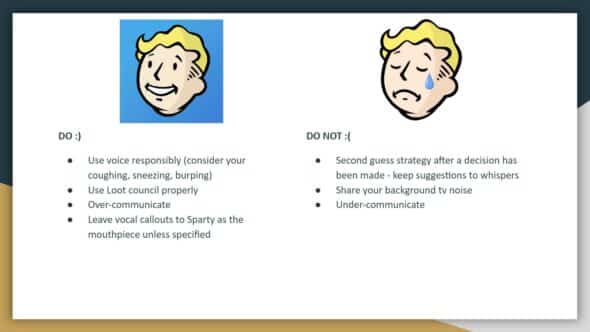
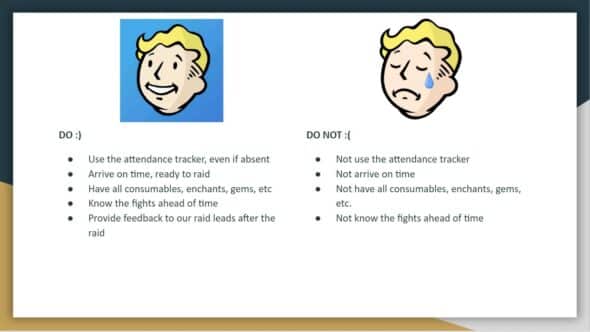
Lastly, I don’t know how I feel about the slides and how they were designed. I sure wish we had more Warcraft related looking assets in them though!

Traits of an Effective Healing Officer

I swear I wrote about this topic somewhere over a decade ago on a different publication but I felt it was time to revisit it. I can’t find it as it might well be lost to the bowels of the internet. There is more to being a healing lead than simply setting cooldowns on a spreadsheet and setting it in advance. After having played in multiple raids with established healing officers, I’ve been so dissatisfied with how they’re running their healers. It often feels disappointing when I’m DPSing during Echo of Neltharion during a raid and then we all wipe to Umbral Annihilation as I glance over and see that we still had 5 raid defensives that could’ve been used. Situations like this turn a surefire progression kill into a well-deserved wipe. It got to the point where I had to step in and just audible raid defensives for the team just so we could get past and move on to Scalecommander Sarkareth. It’s not something I really wanted to do and I regret stepping on the healing lead’s toes like that because I don’t have that authority. They’re a good group but lack the organizational discipline to really advance.

The healing lead serves as the primary point of contact between the raid and the healers. Their role is to establish cooldown usages in advance and make any corrections during progression. Any healer feedback ought to get channeled through them especially if raiders aren’t able to communicate well (because, y’know, no tact).

After years of calling raid defensives and observing other healing leaders, I’ve compiled a list of what traits and styles they all share.

Say something

Communication is key. As a healing leader, step up and start issuing instructions especially early on in progression. Healers are getting used to damage patterns coming in and helping the raid recover from various abilities. Not only that, much of their brain power is going to be spent on just moving around and surviving! They benefit from audio reminders just like everyone else until the encounter becomes so ingrained that it’s no longer necessary.

  • Give specific instructions: Call out player names, then the spell you want them to use. If there’s a time component, tell them to count to 3 then use a Salvation. If it’s ability based, you can say something like, “Handel, on the next Scouring Eternity, use a Rallying Cry.” That will help prime a player to know what to look for and when to use something.
  • Highlight debuffed players: Be prepared to flag individual players with a big debuff or a ticking dot ability on them. Ideally, every healer in the raid should run a glow that flashes players in the raid frames who have been targeted by something. Call it out and remind the healers to target them and for the affected players to use a defensive or a healthstone. After a few pulls, this won’t be necessary.

It’s possible for the raid leader to double up on this and take over cooldowns in addition to other raid duties, but I recommend splitting it up for the sake of mental bandwidth.

Go Off Script

No good healer spreadsheet survives first contact with any raid boss. You never know what your players will do or how they’ll react to situations they haven’t seen before. I was once assigned to cast Divine Hymn during a certain part of the encounter but we phased it ahead of schedule which negated my part, so I banked it for a future unforeseen situation. To make sure it wasn’t a fluke, we were able to replicate that DPS and it allowed us to move certain cooldowns around knowing it was no longer needed in that step.

  • Keep assessing: Pay close attention to raid health, debuffs, and other mechanics. When things get intense, adjust your healing strategy on the fly because you may find that you need extra defensives due to underestimating damage coming in. This might cause you to use a pre-assigned cooldown earlier than expected and will cause a cascade where everything on the list gets moved up one to help compensate.
  • It’s okay to be wrong: Expect to make bad calls. Live with the decision. It’s better to make a swift decision and communicate it to the team as opposed to not saying anything at all when a change has to be made. Give clear instructions about changes, assignments, or positioning. If you end up being wrong, you’ll know what not to do when you’re in this situation again later.

Fluent with Warcraft Logs

I don’t need to go into too much detail here, but being able to review healing logs of yourself, other healers, and the raid is a big benefit. You’re trying to isolate information that could be destroying your raid and players at various moments in an encounter.

Understand Your Tools

Raid defensives are no longer a healer-exclusive domain. Even the DPS has to step in to contribute! To be an amazing healing leader, you need to understand the strengths of the tools at your disposal and know when to use what. There is a time to use Tranquility and Healing Tide Totem versus Power Word: Barrier and Rallying Cry. Even Darkness has an ideal usage. If the raid group is stacked together, a Spirit Link Totem will do the job. Is the raid spaced out and unable to group up? A Salvation might do the trick.

Organize with Viserio’s and MRT

Much of the healing preparation needs to happen outside of raid. Your best weapons here are Viserio’s cooldown spreadsheets (which can be found on Discord) and Method Raid Tools.  Cooldowns are your secret sauce for maximum healing impact. Once you have them planned out, you can incorporate them as a note into MRT:

  • Know the Encounter: Study the raid encounters and understand when the big damage moments are coming. Herolust counts as a defensive cooldown so if it’s being used on the pull, you do have the 40 seconds of extra cast time to help get you through certain abilities. This lets you delay defensives for later on in the encounter.
  • Incorporate other healers: Pick the brains of your healers if you’re not sure how to react to a given ability. Some have an easier time dealing with certain types of attacks than others.
  • Personals and potions: You can assign personal player defensives and potions or healthstones if the situation calls for something and raid defensives are committed elsewhere.

There are even Weakauras that will ping you when it’s your turn to use an ability.

Don’t Stress About Tanks

More on this another time, but the best tanks I’ve raided with take their own destiny into their hands. They know how to call for and sequence single target cooldowns on their own so that healing leaders don’t have to do it for them.

One of the common tank UIs that I’ve seen has them incorporate single-target defensive timers under their player frames so they can quickly glance at what’s available to them.

Troubleshoot Deaths Like a Pro

Even the greatest healing leaders face deaths on their watch. This will take up a big part of wipes. I like to have a dedicated Deaths Details window in addition to damage and healing.

  • Analyze Deaths: You can’t address player deaths without knowing what killed them. Was the player just being bad or did a healer fumble somewhere? I often take a cursory look at the death log in Details but if I need a more in-depth look, I’ll check death logs on Warcraft Logs along with the replay and time step. I’ll even review video footage I have to add some context. Maybe it was an innocuous positional blunder that resulted in a raider falling over. I’ve been this player before.
  • Give Constructive Feedback: State the facts and list exactly what happened. The point is to not find fault, it’s to find solutions. This might mean the affected player needs to stop being greedy and reposition in advance to prepare for an ability. Or maybe they need a dedicated healer or cooldown to get them through a certain part of the fight. There are multiple ways to solve these situations. But share what you’ve learned with the raid group in a supportive manner. Encourage an open discussion and offer suggestions for improvement. Shut down any attempts at player blame or faults lest it devolves into wasted time arguing which serves no one.
  • Missed assignment needs to be reviewed: Once is okay, but frequent misses are a problem and need to get fixed. During Rashok progression early on, I found myself missing the 2nd cast of Divine Hymn. After looking back, I noticed it occurred because my attention was focused on dodging lava waves and then I would simply forget. I made a more conscious effort to watch the timers and remain more aware of how much time I had left on the cooldown of Divine Hymn so I could prepare myself to channel it when needed.

Stay Objective

As a healing leader, maintaining objectivity is your secret weapon. It’s all about making fair decisions and fostering a positive raiding vibe. Here’s the game plan:

  • Stay focused: That’s ice cold water running through your veins. Stay cool, even when things get intense. Stay focused on the task at hand and make rational decisions without getting carried away by emotions. Tackle one problem at a time and then move on to the next one over the course of several wipes. Sometimes healers have to compensate for bad mechanical play until the raid gets a better handle on how to get through it.
  • Address conflicts: If conflicts arise, tackle them proactively. Be the mediator and promote open communication. Sometimes a deeper analysis and review can only happen once the raid is over. Don’t let any fights start in the middle of a raid. If things get even more heated, the raid leader might have to step in and tell the player to exit the raid and go for a walk.

Handling the Parse Lords

This will come up once in a while especially with newer healers. They feel left out and want to feel like they contributed. That’s fine if you have the ability to reposition their cooldowns to be more effective (you can even front load them earlier in the encounter). As players get more gear, the raid damage gets higher which also means less opportunity to do any healing. The only way to address this is to reduce the number of healers in the raid. If you have healers that care about that sort of thing, you can plan for it and rotate a healer out or have them play in an offspec role instead.

If it’s on progression, you can hear them out but put your foot down if you’ve already determined the best place to position cooldowns. We have to stick to the healing script to get through troublesome parts of the boss and it builds up that consistency. This does mean that some healers may not rank as high as others but hey, as long as it leads to a boss defeat.

Of all the officerial roles in a guild, being the raid’s defacto healing coordinator is one of the toughest. Expect to work closely with the raid leader when working on strategy together to see what coverage is available at any given point of an encounter. Not only that, prepare to rapidly iterate or change things up after a few pulls once you discover that what you had planned didn’t quite work.

As much as I hate to add this last part, ego management is real. Raiders might often get annoyed or pick on healers who they perceive as not pulling their weight because of a quick glance at healing meters. It’s your job to figure out and pick apart what’s real and what isn’t. Maybe they are slacking. Find out why and what can be done about it. HPS is often fluid and will vary at different parts of the fight. Unlike DPS, healer’s don’t often burn their CDs at the start of an encounter during Herolust.

Good luck out there!

How to Advance from an AotC player to a CE Player

This is a two part series on advancing from being an AotC player to a CE (Cutting Edge) player from both the player and guild perspective. Today, we look at the player side and what are commonly valued traits.

DJ’s recently killed Mythic Raszageth. The guild had a bit of a slowdown during Shadowlands and went more casual in terms of time and attitude. During our end of expansion survey and post-mortem, the majority of the team answered that they wanted to make a push to being a Cutting Edge team again heading into Dragonflight. Normally, making the jump from an AotC guild to a CE guild takes time. By my experience, it happens gradually over the course of maybe 2 or 3 raid tiers on average. For some guilds, it never happens because they break up or run into a boss wall that can’t be overcome.

I received a question on Twitter from someone who was interested in making that leap. I’ve also received questions along these lines from a few of the other players in the community who had considered applying to DJs but felt they were lacking the experience.

Any suggestions for a AOTC playing looking to take it to the next level and join a CE guild for next tier?

Let’s start with a general foundation. You have your Normal and Heroic guilds. Above that, you have your Ahead of the Curve guild. As that guild decides to push harder and make a play for better loot or a challenge, they might evolve into a Mythic Raiding guild that knocks off a few bosses here and there but gets stonewalled by the remaining final bosses. That’s where most guilds stop. The ones that get over the hump of guild killers end up turning into a Cutting Edge guild. The elusive Hall of Fame guild is generally reserved for the top 100 guilds in both Horde and Alliance, however heading into patch 10.1, it is being amalgamated into the top 200 guilds (regardless of faction). I don’t have experience at that level so I can’t really say anything about it with confidence. In my mind, it’s incredibly rare for someone to go directly from an AotC guild straight to a CE guild. The typical path starts from AotC to a Mythic Raiding environment in order to get eased in before it ramps up (either that same Mythic guild evolves into a CE guild or the player looks for one).

Commitment

Being in a CE guild is a commitment. You can’t take breaks in the middle of a raid tier and expect to come back and waltz into a Cutting Edge achievement. Expect to maintain a high level of attendance. That being said, I’m a big believer in taking a raid night off or two once in a while if you need that small reset and if the raid group can spare it. Commitment is more than just the raid nights. You still have to find the time to help progress your character in other ways. As much as I dislike it, the Mythic+ system is the other way to help fill out your gear and address any weaknesses there. Players try to aim for 8 dungeons complete to maximize their vault. In the early stages of progression, this is ideal. Later on in the tier, it isn’t as important. Nowadays, I stick to getting at least 1 box out of my vault. Sometimes the stats from the gear drops may not be the most optimized for you, but having that extra bit of health can help you survive lethal attacks. When you’re looking to progress on a boss, your own survival is paramount. Your performance will naturally improve later as you get more comfortable (and with gradual gear improvement).

Consistency

Everything you do from your opener to your cooldown usage, to the positioning should all be as consistent as possible. If the raid leader makes a change because there isn’t enough DPS on a platform ad and it’s because you forgot to use a potion or a cooldown, then that change was made for nothing and further imbalances the player assignments. Be the player that everyone can expect and depend upon. I will value a player who consistently hits the 85th percentile over someone who swings from 75th to 95th. Sure their ceiling might be higher, but at least I know what I’ll get out of 85 over the course of 30 pulls. This might be harder to do for healing since that type of performance is contingent on damage coming in, but you can still maintain a degree of predictability of your position and where your major cooldowns will be although this is typically assigned in advance. Expect your raid leaders to direct where major defensive cooldowns will be committed.

Skill

This topic could be its own separate post. It boils down to being good at what you do. Stay alive and push damage while doing the required mechanics. Stay on top of your consumables and execute as best as you can. Stop dying to the same things repeatedly. I’d rather have players learn something new and creative to die from as opposed to not being able to figure out and solve the same thing causing lethal damage over and over. Any player movement needs to be on point. Can’t miss your interrupts. Any target switches have to be quick. It goes on and on. Be up to date with any class or spec changes that you have to account for. Flexibility in spec changing is valued but it isn’t necessarily a deal breaker (I mean, I’ve been a Holy Priest main since the game practically launched).

Lastly, do big numbers when it’s warranted.

Endurance

Mental fortitude is critical! Raszageth took us around 186 wipes (or 206 depending on who you ask). We started working on Rasz on March 17th and kept extending until we got her down on April 8th. But that’s nothing compared to some of the earlier encounters from previous expansions. When you’re progressing on bosses such as Kil’Jaeden in Tomb of Sargeras or Uu’nat in Crucible of the Storms, expect to wipe often and for any kind of progress to be measured in weeks. Hopefully, bosses like that won’t be designed again anytime soon. There are some days when you may choose to sit and not come in because you need a mental reset and this is where a sizeable bench of players comes in handy.

Self-Reflection

Have the wherewithal to look at your own performance and see where improvements can be made. Too often, I see players immediately raid log. The ones that catch my attention stay behind after raid to decompress and discuss shortcomings. Granted, we also raid fairly late for east coast players so sometimes they need to check out and pass out. Even so, during the week, there’s healthy discussion in Discord and the willingness to ask hard questions like, “I died to this and I can’t figure out how to address it.” During our first few pulls on Mythic Terros, I kept taking lethal damage repeatedly. I was simply too slow and any attempts to cast spells were often interrupted because I had to move or risk death. I started off in melee and voiced my concerns before I got the go-ahead to switch with a player at range which made a massive difference.

Communication

You might not need to speak that often to the rest of the team during the middle of a pull but be prepared to talk if the situation comes down to it. Mistakes are going to happen and you’ll need to say something so that someone else can help cover it such as a missed interrupt or if you’re in a bad position. On Kurog, if two people have Absolute Zero and they’re in the same area, one of them needs to speak up and say what they’re going to do. If a raid leader asks you a question, you need to respond even if the answer is, “I don’t know”. We had players who were trialing with us over the weeks and if they took lethal damage and died, our raid leader would ask, “How did you die?” and the silence was quite deafening. Can’t be shy when it comes to communicating quickly about any type of mechanics change, positioning change, or information relevant to the raid. I can tell how comfortably they are communicating in a raid environment based on Mythic+ play. In Court of Stars, CE players will often call dibs on next interrupts for things like Charging Station or AoE stuns and stops for those annoying Imps in the back half of that instance.

This just about covers everything from the player’s side. There’s other nuances to consider. I haven’t even touched upon UI elements but how information is received and how it’s responded to is another consideration. I remember reviewing a fellow player’s UI and was instantly overwhelmed. In a future post, I’ll illustrate my thoughts about how guild leadership can step up from being an AotC guild to a CE guild as there is a clear contrast in how things are handled both in and out of the raid.

Further reading