Stare Decisis in Loot Council

Just about a month has gone by in the formation of Conquest. Loot council continues to be an interesting challenge because the council never knows what sort of situation will present itself.

In today’s post, I wanted to talk about an important concept that’s not only valuable in the legal arena but also in an LC guild.

Stare Decisis

This is a legal principles where judges have to follow precedents established in previous decisions. How does this apply to WoW with respect to loot council? Because the decisions we make in how we hand out loot are expected to be binding. I’ll typically follow the principle of Stare Decisis but ultimately, I won’t hesitate to go a different way in decisions of loot for progressive reasons.

Unfortunately, the reality is that virtually no two decisions are going to be the same. You will have similar cases and they’ll be decided similarly. For example, we awarded a tier piece to a Resto Shaman completing his 4 set (because Chain Heal is still whoa). But if I had my 3 piece and a 4th Priest token drop, I wouldn’t award it to me purely because of the bonus (since I don’t use Greater Heal that often to justify it). It literally is a case by case decision. This is bad in that we’re not following a precedent but good in that we’re willing to remain flexible. Remember that this is a loot council not a court of law. Items will drop again.

Decision to Reward vs Decision to Gear

For guilds that have started progressing through different raid instances, realize that you’re going to come across a dilemma and I guarantee you that it will happen. Every member on your loot council is going to ask themselves the following question when an item drops:

Should I award this item to the player who has run all the 10 mans and done all the heroics or should I award this item to the player who dinged recently dinged 80 and hasn’t had the time to get as geared as the other players?

There are two schools of thought on this and let me tell you what goes through my head every time.

Reward: I like to reward players for their efforts. They hit 80 earlier on ahead of the curve. They’ve managed to work their way into pug groups to get themselves geared. Without their efforts, the guild would not be where it is right now. Their contribution is important and I want to recognize that.

Minimum standard:  The other perspective is to gear up the weaker geared player since that player hasn’t had as much time to get where they should be at. Especially for progression kills, there’s a minimum standard that every player regardless of class has to meet. To make life easier on your raid group, the weaker players have to be brought up to speed.

The past 2 weeks have been a lot of fun for all of us (I hope). Everyone has either reached the minimum benchmarks that have been set in terms of performance (2000 DPS on Patchwerk) or have exceeded it (5000+ DPS on Patchwerk). Now that the minimum standard has been reached, I can further lean towards rewarding players that can use items off of the second level bosses such as Kel’Thuzad and Malygos.

Mind you, I’m still just one person on Loot Council.

Mixed messages?

Following a decision that was made earlier for loot is good, especially when deciding on subsequent items. But don’t chain yourself to it or lock yourself.  Keep your loot council flexible because they have to adapt.

Don’t hesitate to acknowledge mistakes.

Don’t commit.

Don’t promise.

Don’t over deliver.

Don’t bind yourself.

So like Amava says, consistency does matter.

There was a case last week where a tanking neck dropped. Both of our tanks expressed interest. We were at a dead lock. The tanks wore the same neck and they could’ve equally benefited from it. We were taking too long. I gave the instruction to roll it.

I realized later on in the evening after the raid was done that it was a bad idea. Upon further reflection, I doubt I’ll give that order again. The exact reasons that crossed my mind were the same ones that Amava listed. This would’ve been the only time (not counting our first unofficial raid) that rolls were used to decide loot. Our current tiebreaker is an officer who is not a part of the loot council and does not wish to take part in decisions. That’s a temporary fix that I need to address. My options are to elevate another player to the loot council (a DPS cloth wearer, perhaps) or set it so that in the event of a tie, my choice wins (Overlord Matticus, hmm). 9 times out of 10, we do reach a consensus. But things like tier tokens always take a bit longer since they’re useful for so many players.

By the way Amava, yes I do read your blog when I can. I read it so that you can keep me honest. Keep doing what you’re doing. I won’t punish you for speaking out or voicing disapproval.

Some more food for thought for players looking and still deciding upon their loot systems.

Spotlight: Loot Council, a New Upgrade Comparison Tool

loot-council-banner

If you’ve ever been in the hot seat during a loot decision like I have, you already know that it’s important to assess the relative value of the upgrade for all interested players before you weigh in on who should be awarded the item. What if there were a tool that you could use to research upgrades for all your guild members and compare them to each other? That would be pretty cool, right?

My friend Bonkers of Vek’nilash has just developed such a tool. It’s name is–not surprisingly–Loot Council, and it will help any WoW player investigate the gear from a certain dungeon and decide when to pass, and when to bid for an item.

How to Use Loot Council

Once you get to http://loot-council.appspot.com/, you’ll find that you have a form to fill out. To get the most out of Bonkers’ fantastic creation, put in the names of two or more characters of the same class and spec in your guild, separated by commas. To test out the LC tool, I used the names of Conquest’s three resto druids. Then, select a ranking type (Wowhead is working best at the moment) and a dungeon. I put in Naxxramas Heroic. Some Naxxramas normal stuff may still show up–I think Bonkers is working on that.

What you will get is a list of all the items in Naxx that might be of interest to a resto druid and a summary of the comparative upgrade for each player. As with all generic rankings like Wowhead, it can’t tell how important spirit or intellect is to a particular player. However, I find Loot Council’s suggestions to be helpful, especially when I know that I personally want an item. What it helps me see is whether someone else on my team would benefit from getting it first.

Sample Entry

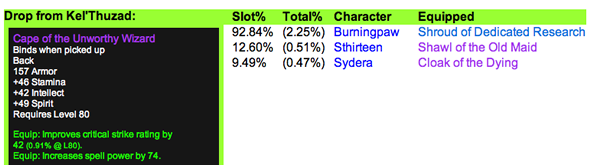
Here’s what you will see when you scroll down to the items that you’re interested in. Even though I’d like to have this item, it looks like a pass to Burningpaw is in order the first time it drops.
loot-council-example

Why Use the Loot Council Tool?

Either for Loot Council members deciding how to award prizes or for individuals deciding whether to pass on an item or spend dkp, the issue of fairness is very important. I always urge people to research their gear, and this tool lets you do that–and, at the same time, research your friends’ gear. Raiding isn’t just about loot–or, in any case, it shouldn’t be. It’s also about friendships, and sharing is one of the things that helps build those bonds. I think it’s no coincidence that the opening page of the Loot Council tool features Oliver and Otto, Bonkers’ two cats–or, I should say, two greedy little piggies who happen to look like cats, and who also happen to be best friends. Oh, if only WoW raiders could be like that. No matter how much we want the loot, we’ve got to learn to share our kibble.

Reader Question: How Do I Find a Quality Raiding Guild?

question-mark

Recently, reader Solarius wrote in with a question that I found so insightful and thought-provoking that I felt it deserved a whole post in response. In his own words:

I was wondering if you had any advice for players who are looking for a decent raiding guild – I’ve read your post on “How do I break into raiding?”, but there are also considerations, like how to recognize a good guild or know when its recruiting and so on. I remember back during BC when Karazhan just had i’s entrance requirements relaxed, and I had the hardest time finding even a Karazhan guild that didn’t either try to run with greens, or have an established cliquish environment.

While I admit I didn’t improve my equipment to the upmost (enchantments and non-green gems being the cardinal sins), I tried my best to be a better raider: I ran PuG Heroics for equipment upgrades, made and offered potions and elixirs, learned how to maximize my DPS rotations, and read up on instance encounters. I still never really made it past PuGing Karazhan.

Since you were writing about guild management and recruitment, I hoped you could cover the other end of the spectrum. As you’ve mentioned before, not everyone advertises on Trade (and I’ve regretted the three times I took those blind offers), the Realm forums can be sketchy, and sites like WoWJutsu are impersonal and lack contact information.

Solarius is absolutely right in that the question of finding a guild has two sides. Yes, players need to do everything that they can to “sell” themselves to the organization they would like to join. There is plenty of information available in the blogosphere, both on this site and elsewhere, about how to apply to a guild. However, how does a player find a guild worth applying to?

I’ve recently changed guilds myself, and you might say that I had an insider’s tip as to where to go, as I’m now raiding with Matticus (who, as I’ve said, is every bit as great a GM as he is a boss). However, I am confident that, if I had to find a guild with no personal connection whatsoever to me, I think I could sort the good from the bad. What would be my plan of attack, and even more importantly, what decisions would I have to make?

If you’re looking for a new guild, consider following these ten steps to virtual health, happiness, and phat loots.

1. Decide whether you want to stay on your current server.

Personal circumstances will probably decide this one for you. If there will be a lot of drama involved when you leave your current guild, a server jump can be a good way to get a fresh start. However, if you have friends and relatives on your server, and they’re not willing to move with you, you may want to stay. In many cases, this decision will be impacted by the overall health of raiding guilds on your server. If there are many active guilds that you wouldn’t mind joining, it could be a good idea to stick around the neighborhood. If your server’s too quiet, or if your faction is outnumbered or always loses battlegrounds, you may be happier with a change of scene.

2. Place advertisements.

What you’re doing is fishing for responses from guilds who are actively looking. If you’re staying on your own realm, make a post about yourself on your realm forum. Be aware that these posts can draw the trolls, but they will get your name out there. However, for a fairly troll-free place to fish, go to the Alliance or Horde Guild Recruitment Forums and place a thoughtful ad about yourself. Quality guilds will search these almost daily when they’re looking for new blood. I found Trinia, an awesome warlock and one of my favorite people in Conquest, that way. Watch to see who responds to your ad, and then research their organization before you take the next step.

3. Observe how your prospective guild behaves.

If you’re staying on your own server, do watch that Trade Chat. Sometimes really good organizations will advertise that way. Write their names down, and whisper the recruiter for more information. If you’re thinking of a guild on another server, make an alt and stand in a major city for a while. Are they an active presence on the server? If so, do they contribute in a positive or negative way? This is far easier to do on your own server, where you are in effect listening all the time to how other guilds behave. If the guild recruits in trade, ask to talk to someone. That will be your best measure of what the guild is really like. I must admit, I judge guilds by their members, particularly their public interactions with others. Just one person spamming trade with obscenities will color my opinion of the whole group.

4. When a guild interviews you, interview them right back.

If you’re invited to chat or get on vent with a guild recruiter, ask questions. It’s not just about “auditioning” for this new person and proving how great you are. This is your chance to quiz them on the issues that are important to you. How do they distribute loot? How do longtime members treat new people? Is there any longstanding guild drama? What do they do when problems arise? These are tough questions, and you’ll be listening carefully to your recruiter’s responses. If she’s being evasive, take it as a warning sign. This interview is your opportunity to find out whatever you want to know–use it wisely.

5. E-stalk your new guild.

Before you accept a g-invite, take advantage of any and all public information about them. Go to their website, and, if you can, make an account there. Read the whole thing if they will let you. If they are well-organized, the site will have at least some content. Raiding guilds tend to have fairly active websites. Watch for too much activity however. All guilds have drama, but beware all-out insult fests.

It probably already occurred to you to check a guild’s progress on Wowjutsu. However, I want you to go with a critical eye. Go through all the listings and find out what their gear distribution is like. How many players are getting geared up? Is there a lot of competition for your class and role? Do the officers seem to be getting everything? Wowjutsu doesn’t track everything, but you can pretty much count on guilds queueing up their loot from first boss kills. If the loot distribution is fair, you will see a lot of different names. In addition, Wowjutsu lets you see the grayed out names of players who have recently left the organization. A high proportion of these can indicate that your prospective guild has lost many members and is trying to rebuild.

In addition to the guild’s own website and Wowjutsu, I urge you to go to the guild’s realm forum and see how other guilds respond to them there. They probably have a recruitment thread up, and there are probably responses from players with other guild tags. If they have a good rep on the server, most of this commentary will be positive. If your prospective guild is comprised of a bunch of ninja asshats, the server forums might just clue you in.

6. Go on a trial run if you can.

A really good organization will let you try out–and even take loot. They will be proud of what they have to offer. Particularly if you’re on the same server, pug a 10-man with some of their members. If you like the personalities of the people you run with, talk to them more in-depth about the guild. Most people will be honest with you, and you’ll get to see their perspective on the good and bad features of the guild.

Remember, accepting a g-invite is not a lifetime commitment. If you’re unhappy, you owe it to yourself to seek your bliss elsewhere. Even if you server hop, you can change guilds again in a month. I am all for loyalty to an organization, but be sure it is a guild that deserves your allegiance. Be fair to your guild, and don’t expect perfection, but don’t be a martyr either. Happy hunting!

Guild Bureaucracy: 7 Ways to Cut the Crap

bureaucracy

Does anyone here read Zen Habits? If not, you should add it to your reader. One of Leo’s (the blogger) posts focused on Steps to Take Action and Eliminate Bureaucracy. I was so taken aback by it that I set out to try to apply a few of his concepts to my guild. There are guilds that I know of that spend so much time on organizational aspects and discussion instead of the one thing that matters the most: Action. Let me share with you a few of the steps that I’ve taken to help streamline Conquest and make it lean.

Clear goals

I lay out the objectives in advance. My guys know that on Tuesday nights, Obsidian Sanctum is the first stop followed by both Spider Wing and Plague Wing. There is no discussion before hand about what we’re going to do. It is all premeditated and there is no confusion. We are going to down this boss starting at this time, end of story.

No meetings

A lot of guilds like to have guildwide meetings or officer meetings to discuss things. That’s what forums are for. I won’t hold guildwide meetings because I know some players get bored by them or just aren’t interested. The ones that want to weigh in on an issue know to do it on the forums where it can be discussed there.

No class forums or channels

Is it really necessary to have individual class forums or channels when you only have one Resto Shaman or one Feral Druid? I decided to consolidate the different forums and communications by role instead of by class. I set up tanking forums, healing forums, and DPS forums. It shortens the overall length of the forums and players don’t feel “isolated” From one another. Tanking Paladins can chat with their Warrior and Death Knight counterparts. Holy Paladins and Priests can discuss suggestions for fights like Patchwerk.

Shared bank tab

One of the bank tabs is known as the public tab. People can deposit and withdraw stuff they need from here. Stuff in the tab are generally items of little consequence like Frostweave Cloth or Chilled Meat. People can toss crap in here for other players to withdraw if they can benefit from it. Things like Enchanting mats or more expensive items get sealed in another tab and only an officer can get to them.

Prepared boss briefings

It’s one thing to read up on a strategy. It’s another thing entirely to apply the strategy with your guild. During my spare time, I’ll modify or implement a plan A ahead of time on the forums. I’ll frequently use Photoshop to draw X’s and arrows like football players. I’ll link to strategies on WoWWiki or Bosskillers. Below that, I’ll follow it up by inserting the names of players who have specific roles. I’ll note that Sydera will be healing Brio on phase 2 of this encounter. I’ll state that Kimbo will be taking care of certain ads. It doesn’t hurt to be specific.

Empowered raiders

Using popular raiding addon oRA2, I can set it to auto invite players of a certain rank within the guild and then auto promote officers so that they have an A next to them. All of my officers automatically get one as well as the tanks for target marking. When raids start requiring CC, I’ll auto promote Mages and Shamans so they can mark their own CC targets as it becomes necessary.

Tanking discretion

My tanks have been given full authority to set the pace of the raid. The speed, rate, and amount of trash pulls are at their discretions. That doesn’t mean I can’t halt them. If the raid has a lingering curse or debuff, I’ll ask them to hold the pull. This is especially true if healers are low on mana. But for the most part, they’re on autopilot.

What other methods can you think of to make your guild or raid more lean and efficient?

Image courtesy of: ngould

Why Loot Council, Matticus?

elrond-council

Veneretio: @behemothdan “Agreed there is no perfect system, but there are good systems and bad systems.”

This statement was, of course, in regards to a post Syd wrote earlier about her early experience with the implementation of Loot Council. Like good systems and bad systems, there are good people and bad people. Power, when used for good, can be used for great thing. When used for bad, can lead to not so great things.

Before I can go into any greater detail, you need to understand the Matticus Doctrine when it comes to raiding. There’s a specific line in there that effectively summarizes my thoughts on loot:

Loot may not be fair and it may not be equal, but I will do my best to ensure that it is effective and not wasted.

A lot of players will say that LC shows favoritism and isn’t fair. I think that’s a matter of perception. What does fair mean? What is your definition of equal? Can you distribute loot fairly and progress? Can it be done quickly?

When we talk about progression, fairness and equality are out the window.

Is fair giving 3 pieces of minor upgrades to the Mage who’s earned that right after months of raiding and then taking a 2 month hiatus but exercising their DKP option when the tier tokens could’ve benefited the Rogue who is still wearing T5?

Or is fair auto looting a crucial piece to a tank to make progression raids that much easier instead of the Priest who can also benefit?

We’re in the business of progression and that means the players have to trust us. Loot gets distributed with the intent to boost and maximize raid performance. And it may not always be “fair”. This means withholding items from the player who frequently AFKs in trash. This means deciding on the player who flasked, brought reagents, repaired and enchanted and gemmed all of his gear instead of the player who didn’t repair to full, asked for Paladin reagents because he forgot to stock up, and isn’t playing 100%.

Factors include but are not limited to:

  • Present gear
  • Tier token count
  • Performance
  • Attendance
  • Attitude
  • “Clutch”ness
  • Etc.

What makes it work?

In order for the system to work, there’s a few important things that I took into account and into consideration:

Numerous Loot drops: Bosses drop at least four items. It’s not a matter of who gets loot. It’s a matter of when. Everyone’s going to get the gear they’ll need and want fairly quickly.

Accountability: It’s not in my best interest to screw people or my guild over. Why not? I’ve got over a thousand regular readers. I just reached the 1 million page view mark a few days ago. I do have a reputation to keep. I don’t want to be known as someone who constantly loots stuff to his friends or someone who shows favoritism all the time. I want to recognize hard work and effort and I want to reward it accordingly.

Progression oriented guildies: I’ve surrounded myself with players who want to kill bosses. They don’t care about the loot they get. They’re not greedy. They’re willing to share it with others who benefit more then they do. I do not have players who only care about themselves. I do not recruit players who are selfish and greedy and want the best epics in the game just so they can look good.

In fact, the biggest problem is when everyone passes or there is no interest at all. If anything, some of the players are too generous.

Member input: Like Syd said, our players are allowed to give some input into whether or not they want an item. It’s a unique system that has worked out for us thus far.

Sometimes decisions will be easy.

Plate Spellpower? A quick glance at the raid shows there’s only one Paladin. Same thing with Resto Shamans.

What makes it not work?

Human error: This is the biggest strength and also it’s biggest weakness. In fact, I won’t hesitate to admit that I’ve already screwed up looting once. You’ll find out more on Monday night on the weekly Post Raids. We’re all human. Sometimes we all overlook things. We all make mistakes. Once in a while, we’ll make the wrong decision.

Loot council cannot work based on the effort of one person. It can only work with the collective effort and trust of the entire guild. Without it, you may as well just go back to using a DKP system. It’s not the best system nor is it by any means perfect. But perfection was never one of the 3 Ps. It’s the best system for the goals and directions of the guild. Players need to buy into it or else it will end up failing.

Mistakes are going to happen. But if I can maintain a successful looting average of 0.990, I think I’m doing a pretty damn good job. For players that don’t agree with it, then my organization may not be the one for them.

I know some of you have had bad experiences with it. Others aren’t so sure if this is the right system for them. Hopefully my blog can help shed the light and paint a better picture of what loot council can do when it’s done correctly.