Mists: Spirit Shell, Chakra, and Party Healing

Blizzard issued another 100,000 invites today and I was lucky enough to get in. Derevka from Tales of the Priest also has the Mists beta enabled. I’m sure between the two of us we can help answer any Priest questions you might have (Save all the math and theorycrafting for him).

Biggest grin inducing experience though?

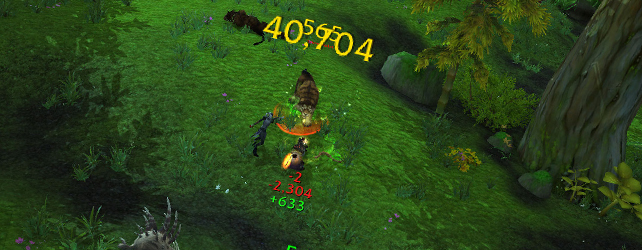
I SMITE FOR OVER 40,000 DAMAGE

On Spirit Shell

On the tanks

Spirit Shell is the new Discipline Priest “heal” (the 2.5 second cast that’s supposed to be mana neutral).

Something feels really off about it. it feels ineffective. I get that it’s used to maintain health of players. It’s the filler spell. But it’s a delayed heal. In a sense, I should feel the same using Heal and using Spirit Shell. But I find that the mobs and bosses just punch through Spirit Shell fairly quick. Since the shield gets broken, the heal aspect never applies (Since 80% of a broken shield is still going to be 0). Tanks aren’t gaining any real health with Spirit Shell.

When using Heal, I can see the physical health bar bounce up and down between heal received and damage taken. Spirit Shell causes the tank health bar to stay around the same or to gradually decrease. I rely heavily on visual bar movement to gauge how much time left before the tank or my party gets smashed. It’s really hard to gauge the buffer I have when using Spirit Shell.

Video of me wiping once on the first boss before taking him out on attempt 2.


I’m not sure if that’s a UI thing or just a priest thing (or a Matt thing). 8 seconds seems like an eternity before a heal gets applied. In a way, I feel as if though I get penalized in a heavy damage environment. Holy sees immediate dividends in when those healing spells are used because you can actually seeplayer health bars move. Discipline doesn’t (with the shields) and we’re left wondering if our shields are still active or if they’ve been punched through or not.

Yeah, there’s a spell graphic thats applied on players. But aren’t your eyes glued to your frames?

On the party

I could throw a Renew on players and they’d get enough healing on them or I could also throw a Spirit Shell and wait the 8 seconds for that to expire for the heal component to apply. Renew, I can use on the run. Spirit Shell leaves me vulnerable. I understand that they’re meant for different purposes, but in this sense, Spirit Shell can be used as a fire-and-forget kind of ability on that Mage who took damage but isn’t expected to take damage again for the next 30 seconds or something.

I’m not sure what it is. The spell’s a great idea and all. But in practice, something doesn’t feel right when healing in instances. I think there should be a minimum floor that the heal of Spirit Shell does (Heals for 80% after absorb expires, otherwise it heals for 20% of the initial absorb amount).

Chakra

chakra

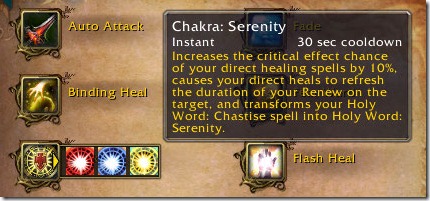
Have to free up some more binds somewhere. Chakra: Serenity and Chakra: Sanctuary are separate abilities and need to be key bound separately. No more having to activate Chakra and cast Prayer of Mending to auto switch to Sanctuary.

Party healing

Admirable job with the balancing of regen and throughput. Temple of the Jade Serpent was fairly brisk the first way through after queuing with a group of random players. I’m queuing in with a mix of normal and heroic Dragon Soul gear (395 Item level, give or take). Raid geared players won’t have much of a problem with it all. Just don’t stand in the water and watch out for fires.

For reference, quest rewards in the opening zone are 372 greens.

Explaining Intellect, Mana Pools, and Spell Costs in Mists

Edit: Fixed comments to allow guests to comment without registering again. Let me know if you run into other bugs.

There’s been some discussion and confusion about mana pools, spell costs, and intellect. I was thrown off when I checked out some of the spell costs. Turns out, I had forgotten about the changes coming up for healers. Here’s a summary of the direction we’re going (all of us healers, not just Priests, mind you).

Even wrote about it in a Raid Rx column a while ago.

  • Every healer gets a static mana pool amount (100k mana).
  • Intellect affects the strength of your spells only. No longer increases mana pool.
  • Spirit still remains a mana regeneration stat. More Spirit, faster regeneration.
  • Many spell costs are being adjusted to account for the change to mana pools.
  • Mana regeneration based on mana pool size is gone.

Here’s a truncated version of the blue post.

With the change we are proposing, Intellect provides bigger heals and Spirit improves longevity. For healers, there should not always be a clear cut answer. Intellect may still be the superior stat, but not by as much as it is today. […] Mana pools can still be large (we are thinking 100,000 mana at level 85) so that it doesn’t feel too bizarre to existing casters and doesn’t feel too much like rage or energy.

What happened to our mana pools?

This is an idea of what the base mana pool of healers will look like. Assume none of these classes have chosen a spec yet.

  • Druid: 20,000 mana
  • Paladin: 20,000 mana
  • Priest: 100,000 mana
  • Monk: 100 Chi (Just a figure I’m using)
  • Shaman: 20,000 mana

Remember, pretend that these are base mana figures.

But there’s more

With the exception of Priests and Monks, each class gains an ability which modifies their mana pool when they select a spec.

Druids, Paladins, and Shaman have their mana pools dramatically increased by 400%. That should then bring everyone’s mana pool up to 100,000. When a Monk switches to Mistweaver, their energy bar will be replaced with mana. As they’re the only monk spec that uses mana, it’s assumed that 100,000 is the base value.

In addition, we think fixed mana pools will help healers scale better with content. Some players seem to be interpreting the 5.0 design as healing 5-player dungeons should be easy but healing raids should be very hard. That is certainly a better situation than dungeons being very hard and raids being easy, but neither is really the goal.

What about the costs?

Let’s use a few of the different healing spells as examples.

Greater Heal ends up costing about 6,000 mana (6% of 100,000). Greater Healing Wave and Divine Light end up being around 8,500 mana (35% of 25,000 mana). Remember that the percentages are centered around base mana which hasn’t been modified by mana boosting talents just yet. This means that their absolute values should be about the same range. Shouldn’t be off by more than a few hundred or a couple thousand. The variance is most likely due to the difference in class mechanics and spells.

So we’re going back to entry-level Cataclysm healing

In a word, yes.

As we were working our way throughout Tier 11, we had to really work on using our mana neutral healing spells (Heal, Healing Wave, etc) as much as possible. As our gear progressively improved, we found ourselves dropping Heal altogether from Firelands and above. Now we’re hitting the big heals and AoE heals more often. You can expect this long term model to stay the same for Mists.

A fight like Phase 2 Beth’tilac on heroic is about as mana-intensive as things get, and that phase doesn’t last very long, so your mana-regen mechanics and cooldowns should be sufficient to keep you going. That won’t change in 5.0.

I still don’t understand

TLDR: Think of mana as energy. It doesn’t scale or increase with gear. Mana regeneration will go up with gear allowing you to cast more spells before running out of mana.

Is Team Melee the New Hotness?

Lodur did a great job last week when he recruited 4 additional players. The catch? They were all melee players. We snagged a Rogue, a Paladin, Warrior and an Enhancement Shaman. Our melee roster now looks something like this:

4 Warriors
4 Rogues
2 Paladins
2 Enhancement Shamans

Gunship 2.0 turned into a challenge with just 6 ranged DPS players.

The guild historically has been melee heavy but not to this extent. As much as I would prefer having more ranged players as options, the raiding reality is to take the players we can get and find a way to make it work. Between the end of this expansion and a new MMO that’s holding player interest, it’s a little tougher to pick up players of the right class.

I’ve found some perks with a melee heavy raid, however.

Stuff dies really fast

That change to the melee buff (where it’s now 20%) makes a bigger difference. With trash and adds dying faster, it means overall less healing needed.

Closer proximity

Melee players typically stand in one location – Right behind the butt of the boss. I don’t have to worry about being out of range. Spells like Holy Word: Sanctuary are that much better since the melee players are in one tight location.

It’s nice to have a comfortable number of raiding players again. Holiday season is always tough. The next areas we need to shore up are ranged DPS and healers.

Now that we’ve gotten Deathwing down, we’re starting work on Heroic Morchuk (Norris). For those of you that have knocked it out already on 25 man, what would you suggest?

Did Cataclysm fail?

So, you’ve probably seen a number of these posts around lately, and to be honest you shouldn’t be too terribly surprised. We’re at the end of a cycle, with the last raid tier coming out soon and people already looking forward to the next expansion and the promise of bouncing pandas. The topic lately is whether or not that Cataclysm has failed as an expansion.

I figured the time is right for me to chime in on the topic, and I promise you it will be relevant to the site.

Healing Design

At the onset of the expansion, there were some very bold statements made about healing as a whole. They basically amounted to the following;

  • Shaman are the healing model that all healers will follow
  • Triage healing is vastly more important and mana is a concern
  • healing will be a lot harder and require smart decision making

So, in this regard did Cataclysm succeed or fail? Well to me the answer here is two fold. They both succeeded and failed at the same time. At the start of the expansion healing was definitely harder, mana consumption was much more of a concern and shaman healing really was the model when it came to triage healing. Note how I said at the start of the expansion. There was a bit of a problem though, once you started getting a pretty good head of steam going and gathered your gear the “model” started to fall apart. Spirit levels and regen abilities after heroic dungeon gearing were enough that some healing classes could just completely ignore the healing model. I’m casually whistling in innocence as I look at Mana Tide Totem from a year ago, I assure you. The problem exacerbated itself when some healing classes’ masteries got tweaked, and raid gear started circulating.

At this point, triage healing isn’t really used unless you’re just starting out, and some healing classes are just blowing others out of the water causing a lot of internal debate among raiding groups as to what the best healing setup really is now. Things are shaping up to be better in tier 13, but the healing model through tier 12 I would venture to say hangs at the edge of failure. We’ve been assured that the healing model will remain in tact for the next expansion, but only time will tell if that is true especially when adding a new healing class into the mix next expansion.

Guild advancement and recruiting

The new expansion brought with it the guild advancement system. Guilds earned experience points based on questing and the activity of the guild members involved. The guild was able to level up from level 1 to level 25 carrying various rewards such as XP boosts, mount speed increases and even alchemy patterns for flasks for the entire raid. It also came with some other perks like Heirloom gear helmet and cape slot items, mounts and pets as well as a Mass Teleport and Mass Resurrection. Honestly guild advancement was a huge success as far as adding perks to guilds that get rolling and stick to it and work together. Guild achievements also added nicely to this and added a further sense of accomplishment to a guild in certain respects.

The problem is that the success of the guild advancement system, however, in my eyes became a contributing factor in a problem that this expansion has had that I haven’t seen in either of the previous ones. Stagnant recruiting. Recruiting flat-out sucks right now to be honest. Any losses from people leaving the guild or leaving the game become increasingly difficult to replace. Let us face a simple truth, the game has been around for over 6 years at this point. People are taking a break. Maybe not out-right quitting, but they’re definitely going to start taking some vacation from Azeroth around this time. Before Cataclysm, replacing losses wasn’t nearly as difficult. I attribute this partly to the guild perk system. When a player leaves a guild, they lose all reputation they’ve gained with that guild. They then start from scratch just like with any other reputation when they join a new guild.

So the problem is that a lot of the guild perks don’t kick in unless you’re Honored with your guild. This can be a very unattractive prospect, especially when you consider there is a weekly cap to the reputation you can gain. Not only can swapping guilds be a daunting task on its own, but when you combine in extra things like rep to earn it adds to the heap. So, people are staying put in whatever guild they are in for the most part. Guild mergers seems much more frequent now, where whole groups of people make the commitment one way or another, but recruitment is certainly at an all time low.

Raid design, gear options, and accomplishing goals

This is another measuring stick by which to judge the success or failure of the current expansion. Raid design was a bit different this go around. In Wrath, all of the raid tiers were contained to one single zone. You didn’t have to go from place to place in order to see all of a raid tier.  In Cataclysm, the starting raid tier was divided between not one, not two but three different locations to contain all of the bosses and events. Honestly though, I think that served to make things a little better. Having different locations broke up the monotony of raiding in one single zone for however many hours a week. Some of the mechanics were fun, and the boss fights had the potential to give you at least some challenge. Overall I’d say it was a good tier. It reminded me of Burning Crusade where tier 4 and tier 5 were divided between different zones in different locations, breaking the long dredges through BWL that we were used to at this point.

The use of valor points to purchase tier gear, as well as off set items, was a smart move at first. It allowed a certain gear gating of the content as players had to earn their valor points to purchase the raid gear. Keeping a few pieces as raid drops only also made perfect sense. It eliminated the fighting over tokens at least a little bit, and while it could be annoying have to wait to restock your valor, it served it’s purpose well enough I think. Listening to the developers at BlizzCon it would appear that they too really liked how tier 11 worked out and will be continuing that style of breaking up the raids going into Mists.

One of the goals for Cataclysm was to reignite the fire the propelled the game to 12 million subscribers and get people excited about the game. New graphics throughout the world, Azeroth split and changed. Entire zones looking completely different and completely different starting zones and quests for the races of Azeroth. Well, this was both successful and a failure at the same time. The new starting zones did reignite the flame somewhat, but mostly in people with alt creation.  Some old players did come back to check out the new zones and explore some of the new content, but it didn’t quite have the kick that it originally intended. Subscriber rates pretty much stayed the same, and the number of active toons remained about the same as well. It just didn’t quite have the shakeup that was expected.

So what is it? Success or Failure?

Well, that’s the whole point of this post right? The big question. Is Cataclysm a success or a failure? The answer is honestly both. There are things that Cata did exceptionally well, and things that it fell behind on. To be honest a lot of the goals were pretty damn lofty from the get go. It was ambitious and new things were tried, combined with old things that we knew worked. Not everything was ever going to be achieved just based on the pure scope of the original intent. There were things it did well, and things it didn’t do quite so well. That said it was hardly the failure that some folks seem to think. The content is still there, there is still plenty of value in the game, and for a game that is going to be rapidly approaching the age  of 7 they can boast a lot of good things. The game hasn’t really lost too many subscribers and is going strong. Oh and they still get my money every month, and I signed up for my hear subscription with free Diablo 3 “phone”.

So what do you think?

Battle.net Authenticator Changes, Don’t Panic!

So in-case you missed it, there was a recent change to how our accounts are authenticated, here it is again for you again if you didn’t see it.

If you use an authenticator – and we hope you do – you may soon notice that an authenticator prompt may not appear with every login. We’ve recently updated our authentication system to intelligently track your login locations, and if you’re logging in consistently from the same place, you may not be asked for an authenticator code. This change is being made to make the authenticator process less intrusive when we’re sure the person logging in to your account is you.

We hope to continue improving the authenticator system to ensure the same or greater security, while improving and adding features to make having one a more user friendly experience. If you don’t already have a Battle.net Authenticator attached to your account, don’t wait until it’s too late – http://us.battle.net/en/security/checklist

Well, this statement has raised quite a few questions. Many of us in the gaming community work in Information Technology / Information Security, and we are quite honestly interested in having more information on this.

Now before I get started I want to have a note here that the information after this point will represent a more general view of internet protocol. This is not intended to be a tech manual, just the musings of an internet worker who is also a gamer.

There are a couple ways that you might authenticate a computer at a physical location. One is by authenticating the public IP address that is reaching out to the login server. If you see multiple requests from the same IP in a short period of time, you can assume this is the same person to a certain degree. This works in part because IPs are purchased by ISP’s and assigned to a specific region. After that, you as the user rent the IP with a lease sort of like renting an apartment. If you have a static IP, you have a “permanent” lease on that particular IP. If you use a DHCP service, like cable internet, it may change based on what’s available. Every time you get a new IP, it’s from your local region and the local pool. It could also authenticate by not only your public IP address, but also your computers MAC address. A MAC address is a unique identifier that all networking devices have. Think of it like a social security number for your computer. Each one is unique per device. There is however a couple potential problems; IP’s / MAC addresses can be spoofed. Not that it’s something you should be worried about all the time, but it is a fact that it can happen. Also if you have a Dynamic IP and it solely authenticates by the address, every time your IP changes it could cause issues.

Another manner is the creation of software tokens that are placed on client end at the point of logging in. Essentially you log in to your account and a software token, or marker of a successful login, is created on your machine to further authenticate you. By doing this it can validate the token on your machine instead of requiring you to to punch in your authenticator code every time.  The potential problem with software tokens is that if your system is compromised due to trojans or other methods, it could result in a compromising of the security token. Again, while this isn’t something to worry about all the time, but it does happen.

There are several other methods you could use, but those are probably the easiest.

So what method is Blizzard using? Well I decided to perform a little experiment last night to see what I could gleam as far as information goes. Since I work for an ISP in my daily Clark Kent style life I have access to a few things that I can do easily (and legally) to perform a simple test.

Step one was to pick a new IP. I changed my IP to one available from a local pool in the lovely state of Wisconsin. I logged into my Bnet account, it asked for my authenticator normally. I logged out for a period of time, roughly 15 minutes, logged back in and it did not ask me for my Authenticator.

Step two was to change back to a local IP address from back in good old NY state. I logged into my bnet account, and it asks me for my authenticator code. I logged out for another 15 minutes and then logged back in and it did not ask me for my authenticator.

Step three was to repeat step one, but this time after it did not ask me for my authenticator I logged out and completely shut down and restarted the computer. Logging back in required me to use my authenticator. I repeated the steps with a local IP with the same results. Continuing this process multiple times confirmed the same results, each time with different IPs.

From this incredibly simple experiment it would seem that the new authentication process is using a combination of validating your IP either for location, consistency, or potentially both as well as potentially a software token on your machine validating it after a successful login. Every time you cold boot your computer it will remove temporary data, including any software tokens created. Whether or not this is actually how Blizzard is doing it, we won’t know unless they say something.

There are a couple things that confuse me slightly. First is that there was no prior announcement to the change going live rather than it just appearing. I’m wondering if this is a knee-jerk reaction to the recent string of hacker invasions going on across the blog-o-sphere. Second the lack of explanation of the process is concerning, not the exact process per say, but knowledge that this was carefully thought out and not hastily implemented would be comforting, as well as hearing the reasons for the change. Lastly is that there is no option to opt out of it, it just happens. If nothing else I am a creature of habit, and I like typing in my authenticator code every single time. It’s a preference, but it’s something that I would like to have the option to continue doing.

So in the end, while my first reaction to the change was not a positive one, I feel much better about it after my simple experiment. At the very least we know that they are checking for multiple factors before just allowing you to log in. While on a professional level I would love to know more about the process they are using, I don’t think it’s anything we should be too overly worried about. Now if only we could get that pesky opt in/out toggle…