A Fond Farewell to AVR/AVRE

I’m sure you’ve heard the news by now. In patch 3.3.5 Blizzard intends to intentionally break AVR/AVRE. It is not the first time that something like this has happened, but it does strike me as a bit odd as to the reasoning behind it.

If you missed the full announcement here it is for you

Bashiok — AVR Mod Broken in 3.3.5

This is a notice that we’re making changes in 3.3.5 in attempts to break the ability for the AVR (Augmented Virtual Reality) mod to continue functioning. For those unaware, this mod allows players to draw in the 3D space of the game world, which can then be shared with others who are also using the mod. In some cases this manifests itself through drawing/tagging/defacing the game world, but more popularly is used to give visual guides for dungeon and raid encounters.

We’re making this change for two reasons. The invasive nature of a mod altering and/or interacting with the game world (virtually or directly) is not intended and not something we will allow. World of Warcraft UI addons are never intended to interact with the game world itself. This is mirrored in our stance and restriction of model and texture alterations. The second reason is that it removes too much player reaction and decision-making while facing dungeon and raid encounters. While some other mods also work to this end, we find that AVR and the act of visualizing strategy within the game world simply goes beyond what we’re willing to allow.

The change we’re making in attempts to break the functionality is light in its touch and approach. When blocking any functionality we run the risk of affecting other mods, but we’ve targeted the changes as carefully as possible. If we find that the AVR mod (or any mod attempting to replicate its functions) are usable after 3.3.5 we will take further, more drastic steps.

Now don’t get me wrong, I’m not saying that they are wrong to not want to see mods like this disabled, but they claim it is because of the invasive nature of the mod and that it allows altering and interacting with the game world. Well, we interact with the game world all the time don’t we? We kill a mob, that’s interacting right there! Silly statement I know but it is the truth. Simply by being in the world and playing the game we are interacting with the world and on some level altering the state of play for those around us. As far as calling it invasive or that it alters the game world, I don’t know. Is it any more invasive than any other boss mod? Take a look at most boss mods, they mark players that are affected by effects, provide warnings both visual and audio before a boss does an ability and effectively simplify encounters. Some even give you arrows telling you where to run from an effect, others include range finders to tell you how far away you are from other players in order to avoid making some boss abilities chain or augment. Mods like Auctioneer allow you to alter the way you interact with the auction house, postal allows you to modify how you access the mail in the game world, power auras allows you to be notified of every single buff and debuff in the game and mods like grid allow you to alter how you view the members of your party and allow you control over what information is filtered through and omen alerts you to threat compared to all other party members.

So what makes AVR so taboo? I was thinking about it and it reminded me of a funny story from my pen and paper days.

I was playing Dungeons and Dragons (tabletop pen and paper version) with a group of friends. Our party was supposed to set up an ambush to take out a band of mercs about three times our size. I was playing a halfling rogue at the time and was the party’s wet works guy. I would sneak around, spy on things and help set traps. Our fighter in the party was a tactical genius (the player has since moved on to a military career and it is very fitting for him as he honestly was a huge strategist) and came up with a plan that involved key movements at key points in time. My character happened to have a bunch of chalk, and came up with the idea of setting markers on the walls and floor to indicate thresholds for those lying in wait. It could indicate when to attack and after a point when to break off and regroup or attack from a different direction. The fighter loved this idea, and we set about marking the ruins we were using as the kill zone in markings the party would understand. We then set various traps and waited for our ambush to take place. As the mercs entered the ruins we watched from hiding as they breached the thresholds, we attacked. The mercs moved past another marking and we dove back into hiding and onto the next position. This continued until the band was no more. We took no casualties and had a well executed plan thanks to a series of chalk markings. The GM joked at the time of having allowed us to have such general items and them coming in so handy.

So, is AVR so different than the chalk we used in that game session? I don’t feel that it is when used to say, mark spots on the ground for people to collapse to or stand at during certain encounters. On a personal level I will miss it not because of anything it did during a boss fight, but I truly loved the way it interacted with Totem Radius in showing me the effective range of my totems in real time. That said I wont lose any sleep over it going away, but I think Blizzard may have been a bit hasty in their aggression towards this mod. Personally I don’t feel it is any more invasive than any other mod they currently allow in the game, and honestly once you allow mods or addons of any sort you are inviting a sort of intrusion into that which you created.

Did it make things too simple and remove player thought from the game? I don’t think so either, I’ve seen enough people with it installed still mess up quite frequently. It was not a guaranteed win for boss fights otherwise we would see a lot more people having downed ICC heroic mode when using this. In the end a mod is no substitution for attentiveness to the game and player skill. This one just happened to let us John Madden things a bit, and occasionally draw funny objects where they don’t belong.

So what do you think? Do you support Blizzard decision to break the mod? Do you think it made things too easy? Will you miss being able to draw stick figures randomly in ICC?

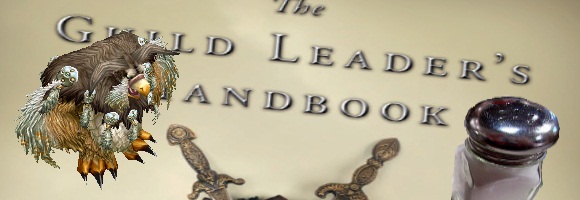
Review: The Guild Leader’s Handbook, Mimetir Perspective

“Because it takes a village to slay a dragon.”

You might look askance at me for getting excited about that sentence. I wouldn’t blame you. It’s the blurb on the back of the Scott F. Andrew’s Guild Leader’s Handbook.

I admit I got quite excited when the opportunity to get a copy crossed my inbox. I’ve been involved in leading online communities in games for near on 10 years now, but I know I’m still learning about leadership and communities all the time; the nature of the games and roles within them is one of constant change. I figured that I might well learn  from Andrews’ book and at the least it’d be an interesting read.

I know Lodur’s already shared his thoughts on it here but I’m going to, too. Not because I know Scott Andrews (I’m not affiliated with him or WoW.com in any way, convoluted or otherwise) but because if you visit this site you and I may well have something in common: an interest in guild leadership. And if that’s the case, you could do with getting yourself a copy of this book. And, to be on the safe side, a pinch of salt.

First and foremost I must salute Andrews. Guild or online leadership is a topic which many people would consider frivolous; Andrews approaches it with the solemnity and respect it deserves. His writing style manages to convey that all the way through the book.

At every turn we’re reminded – no really, guild leading is Serious Business, no joke. Players are real people: so are you. That’s something I respect and it’s something I’m continually harping on about as a misunderstood fact of online communities. Another tune I regularly pluck is that these games are meant to be fun – again, Andrews keeps ‘fun’ as one of the integral principles throughout the book, constantly reminding his readers that having fun is one of the main aims for both themselves and their charges in the communities they’re building.

Saying that, his writing style isn’t *too* serious. The Handbook’s very readable thanks to a style which flows well, explains concepts immediately and simply, and gets to the point in short and understandable sentences. In this way the Handbook is very accessible to anyone from new or prospective guild leader to old hand, or even a player with no intention of leading. Andrews also cross-references his material between sections, enabling you to flick back and forth as your interest takes you.

The Handbook’s carefully thought out sub-sections also aids its accessibility – they help split up the text, as do the regular diagrams and tables dotted throughout the book neatly reinforce his points. All of this helps Andrews to mint his topic as one not to be snorted at.

As to the material itself – there’s no doubt that Andrews is a veteran of leading online communities. I was impressed right from the introduction as Andrews goes straight for the jugular, calmly asserting the dichotomic challenge that guilds pose for their leaders. After all, guilds may be part of a virtual or ‘unreal’ realm but they are populated by real people, whom, as Andrews points out, guild leaders can’t physically see. I’d not often considered this or its ramifications before, but he’s right – not being able to see your members face to face, and able to gauge whether their body language is trying to tell you something, or if they’re only smiling with their mouth – these are things which make online leadership at once both more personal and more impersonal. As Andrews rightly recognises – a unique challenge, but not one impossible to get right.

There’s a lot of his wisdom I both like and wholeheartedly agree with. As a bit of a ruffled-feathers veteran myself I recognise that I – and others – can become entrenched in views on the game, playstyles and player expectations. So I was pleasantly relieved to see that Andrews expertly manages to keep an objective and unbiased voice throughout. His comparison of the machinations of guilds of different sizes is well explained – but then he moves on to a potentially volatile definition – that of ‘hardcore’ and ‘casual’. I’d disagree to some extent with his definitions – by his definition my own Kingslayer raiding group would be casuals – but the topic’s a good example of where he manages to tread a minefield without putting a foot wrong.

Andrews successfully illustrates most of his points with examples. He talks about player types and gives examples of how different types might interact. Crucially he also underlines the fact that players – again, as real people – aren’t as simple as to be a single player type, but rather composites. It might have been easy to forego this point in the name of generalisation: happily Andrews notes it. It’s a good example of little details that guild leaders have to watch out for and which might not cross our minds until it’s pointed out, possibly quite sharply. The Handbook rescues us from being thrown in at the deep end in numerous murky ponds.

Saying that, there are a few points where Andrews’ advice appears clunky. When talking about how to prepare for raids as a raid leader he basically recommends that one tell the group everything about the fight. Personally I’ve found that breaking down a fight into what each role (tanks, healers, DPSers) need to know is popular both in my active raid group and PUGs. In my opinion dumping all the information on people just drowns them in it, but giving them the bit that pertains to them makes it bite-size. He then goes on to talk about the importance of morale and constructive communication in post-combat raid leading, which I thoroughly agree with.

My biggest qualm with the Handbook is that it generalises a tad much. Sure, Andrews is presenting a guide applicable to all types of communities in all types of MMOs – he has to generalise a bit. But if you’re using the book in relation to a specific game you may well need a pinch of salt. For example, Andrews’ recommendation to be recruit by going out among strangers and recruiting is all very well and good, and worked brilliantly for me in WoW a year ago. Nowadays if you showcase your leadership abilities in a LFD PUG in WoW many people will think you’re being weird or pushy – and tell you that. Regardless of peoples’ reactions to a stranger from another server being social at them, the game simply doesn’t facilitate re-grouping with prospective recruits cross-server at present.

He also goes into some depth about the differences between raid and guild leading. This is the only time that I wholly disagreed with his expertise. He suggests raid leading and guild leading are a completely different kettle of fish (who puts fish in a kettle anyway?); in the former role you need to be prepared to shout at your raiders. Whether it’s due to different experiences or just his need to generalise, in my opinion Andrews’ wisdom fails him here, as my Kingslayer group stands as at least one example of a raiding style which succeeds at endgame content without screaming at or chewing over my raiders, which he seems to suggest all raid leaders will have to be prepared to do. If this is what he meant I believe him wrong – if not, I believe the text misleading. I’d quite like to hear Andrews’ take on that!

All in all, sodium chloride taken into consideration, I think Andrews’ book is a timely addition to the MMO world – and to my own bookshelf. His closing thoughts are as grounded as his opening ones and underline the fact that MMOs are a reality; whether or not individual MMOs can keep up or fall by the wayside, MMOs as a genre will be around for a long while. They provide something for us as players – the chance to partake in, create and resolve conflict situations – which ties them, as a platform, to us as real individuals.

Lodur gave publication details for the Handbook in his post but just in case you missed them;

The Handbook retails for $24.95 US ($31.95 CDN). It can be purchased directly through the publisher’s website.

Book Review: The Guild Leader’s Handbook

There is a book for everything it seems. Some will tell you how to hack an iPhone, others will tell you how to cook rare and exotic treats. In the gaming world there has been everything from strategy and content guides to art books and everything in between.

A few weeks ago a new book hit the stands, The Guild Leader’s Handbook by Scott F. Andrews. Scott is not only an accomplished and long time  guild leader in World of Warcraft, but also the author of “Officers’ Quarters” on wow.com. His book takes a look at what it is to run a guild in today’s modern MMOs and offers readers both looking to start a guild and those who have been at it a while, a cornucopia of information from his collected experiences. Today I’d like to share my thoughts on the book with you.

Before we begin I’d like to make a few things clear. Firstly, Yes I do write for wow.com as one of the class columnists. This does not mean however that I will be unfairly biased towards the book. I have had little to no interaction with Scott and anyone who knows me or has listened to my podcast knows that I do not temper my criticism and critiques based on acquaintances or tangential relations. In short, friend or foe I try to tell it exactly as it is and as unbiased as possible. In mathematical terms we would call this “Correlation does not imply causation”. Secondly, while I myself am not currently a Guild Leader in WoW, I have lead numerous successful guilds, super-groups, and various other groupings in many other games. I am however still the Healing Lead and one of the raid officers for the guild I call home, and thus in a leadership position within the structure.

The first thing I noticed when opening this book, is the level of accessibility. It was very well written and very easy not only to read but digest. The concepts and ideas in the book are thoughtfully laid out and the way the topics are grouped not only make sense logically, but allow the material to be more easily digested. Potentially confusing concepts are quickly explained, often times with a real life scenario that the author has experienced himself. The second thing I noticed while reading this book is the confirmation of the author’s depth of experience. The familiarity he writes about the topics is comforting and also conveys a sense of certainty that is easily lost when writing something of this nature.

The book itself covers many topics such as;

  • Forming a guild and making it successful
  • Choosing a guild size and focus
  • Dealing with guild drama
  • Differences between leading a guild and leading a raid
  • Loot distribution
  • Alternate styles of guilds (PvP, RP)
  • Choosing officers
  • Guild Morale
  • Planning for the long term
  • Dealing with Real Life

Seems like a lot to cover in such a small book doesn’t it? It is, but the author cuts out most of the unnecessary and leaves in the most relevant information to the topic. Each topic is subdivided and dives into specifics and does so with the perfect amount of detail.

There were a few pieces that really stood out to me while reading this. First was the section on forming a guild. Beyond setting a size and focus for your guild, the author talked about a topic that I think deserves some attention. Forming a guild identity and presence. For any established guild or group, their name and longevity carry a certain weight to them. If you think about any guilds, corps or fellowships you may have come across, I’m certain you can find at least one where their name is well known. For a new guild starting out it can be hard to forge an identity and establish a presence. The author offers some solid advice for creating a server presence. This ranges from specializing and becoming rock solid at a particular goal, having a history of cooperation with other people and guilds to having fun contests and events. One example that I found particularly enjoyable was the idea of taking a completely meaningless piece of land in the game and claiming it as your own, while challenging anyone to take it from you and doing anything you can to hold on to it. That would certain generate some notice, and could be a particularly fun event.

Next was explaining the differences between leading a guild, and leading a raid. The distinction is one that sometimes goes unnoticed. A lot of players seem to feel the two are always synonymous. The author explains the characteristics of a guild leader very well and talks about the shift in personae needed to lead a raid. The two can often times be polar opposites of each other. A guild leader is at the end of the night the ultimate authority of a guild. They can control who becomes officers, who is kicked or invited and tend to be looked upon as the arbiters for any guild disputes. Compassion, openness, friendliness and approachability all play very well to a guild leaders station. A raid leader has to evaluate performances constantly while keeping the group focused. They have to play the role of team captain, coach and player all at the same time. Leading by example, but also calling out problems and fixing issues as quickly as possible. This can sometimes involve not being very nice and squishy in your assessments. I was quite pleased to read this section here and it would be something I encourage not only people in leadership roles to read, but also those in a raider position. It is very much like being friends with your boss outside of work. When you’re at work you still need to work, and it’s your bosses job to keep you focused.

Another part that particularly stuck out to me was the section detailing real life interactions and issues. Even though this is a game, it is a social network. You are interacting with other players regularly, and you are devoting time out of real life to play this game with other people. As a result real life will always impact a gamers life and a game may affect the life of those that play it. This section of the book covers topics like dealing with addictions (both substance and potential video game addiction), Depression and mental illness, sexual predators, relationship problems, family problems, burnout and criminal confessions. These are real life topics that can and do affect people who play MMOs. This section offers advice to deal with these situations as they arise. Let’s not forget it wasn’t so long ago that a criminal was tracked down through WoW by law enforcement.

This section also talks about planning real life meet-ups. Investing as much time as you do in a guild there may come a time where you want to meet the people behind the avatars face to face. It sometimes requires a lot of planning, but can indeed be exceptionally rewarding.

So in the end what does this book really have to offer?

For the new guild leader or leadership role

A plethora of information that is neatly gathered in one place for you. There is a lot that goes into forming and running a guild. This book takes the information and neatly bundles it for you for easy consumption. The information contained in the book is very accurate, and is very universal in it’s approach. The advice offered is solid, well thought out and has been tried and tested by the author himself. The book may have items you never thought to consider, or just did not occur to you. It offers a new officer or guild leader a chance to be prepared and also educates you on exactly what you can expect. Everything from personalities in the guild and group dynamics to planning for the future and longevity of your guild. All the basics you could possibly need to know are detailed here for you.

For the old-hand

Even if you have been playing MMOs for a long time and are quite experienced at leading groups, running guilds and leading raids, this book will offer something that can often times be lost over time. Perspective. We fill these rolls for so long that things become second nature to us. Like everything sometimes it’s nice to have a refresher. No one is perfect 100% of the time, we all make mistakes or forget things. The way I view it is like this. Next to my computer I have a series of books for programming, APA style and formatting guides, marketing and business books and a variety of other reference material. No matter how long I’ve been doing something, there will be things that I will forget. Having these books handy gives me a reference. somewhere I can go to clarify questions and vague points or remind myself of things I may have forgotten. This book now has a permanent place on that shelf. For us old hands this book is a perfect reference to when we need to get back down to basics.

For the non leader

Even if you are not in a leadership role this book can offer you a great insight you might not have otherwise. Ever wonder why your guild leader made a particular decision but don’t really want to ask them? How about when a raid leader does something that you’re not quite sure of? This book will give you a basic understanding of what it is your guild’s leadership has to go through and constantly juggle to make sure the group remains stable and that you have a place you can unwind and have fun.

I applaud the author for this book. I found it easily accessible, accurate and a fantastic read. I was able to identify with the examples he presented right away and could have compared them to any number of stories from my own past in gaming. This book is a great starting point for anyone looking for form a guild, new to an officer position or for those who just want to understand what happens behind the scenes of their groups. On a personal level, reading this book allowed me to catch something happening in my very own guild that I almost missed simply by reading about it and being reminded of it.

The only criticism of it I have is that I feel it could have been longer.  Some of the sections could have been more fully explored and may have benefited from having a little more room to breathe. The book ends at a surprisingly short186 pages.

I feel it is well written, logically put together and is a must read for anyone seriously involved in MMOs and guild structure. Even with consideration of the length I feel that is well worth the money, and even more worth the time you would invest reading it.

The book retails for $24.95 us ($31.95 CDN) and can be purchased directly through the publisher’s website.

If you’ve read it and would like to share your thoughts on it we’d love to hear your opinion on it.


Still Going to Run 25s?

chain-link

The big Cataclysm announcement this week is the changes being made to raid progression. To summarize:

  • 10 and 25 raids will share the same lockout
  • Heroic mode will be toggled individually per boss
  • The difficulty gap between 10 and 25 raids will narrow
  • 10 and 25 man bosses will drop the same items
  • 25 man bosses will drop more items
  • Multiple, smaller raids instead of massive ones
  • Continued gating
  • Initial raids tuned for dungeon blues and crafted

First reaction? Surprised. It’s as if someone splashed me with cold water. Again, with the rewards changes and time investment changes, the game is shifted to further accessibility. There are some aspects that I like, and there are other aspects I’m a little wary of.

On reduced commitment

Having the same lockout and having the same item qualities drop will free up time for players to do other stuff. Your raid won’t suffer a penalty either if a number of players unexpectedly drop out for a day due to vacations or dog shows or what not. If you’re short several players, you can still pull off 2 x 10s and not miss a week of gearing up.

It certainly does feel like the raiding progression game is going to slow down.

What needs to happen for this to work

Please, do not screw over the players who prefer to do 25s. I believe some of the extra rewards are badges, loot, and gold. The extra gold is nice and all but for most organizations, it isn’t a problem. Having extra badges will speed up the gearing process for sure.

1) Increased item drops: And I mean a lot more. To put it into perspective, if you take down Marrowgar on 10s and 25s, your raid gets access to 5 possible items. If you were wearing ToC or Ulduar level gear, any of those 5 items could have been an upgrade. What drove some players to run ICC 10 and ICC 25 was that any item, whether it was a 264 or 251 level, would’ve been used regardless. I know I’d like to see 6+ drops to truly make it worthwhile.

2) Other incentives: Mounts or titles? I don’t know. But there needs to be something that’ll keep players motivated to do 25s. I’m not sure if money and badges alone will do it.

3) Difficulty: I don’t know in what direction the raid difficulty it being switched to. Is the difficulty going down or increasing? It should be just as punishing either way, I think.

This is the fear. The fear is that players will opt to switch to 10 mans that is further into a raid instance than a 25 man when they’re only 3 or 4 bosses in.

From a player progression standpoint, would you rather be in a 25 that has taken down 2 or 3 bosses or a 10 man that has taken down 7 bosses in a zone? Knowing that the item grade is going to be the same, I’d say that most players will opt for the 10 man.

On the other hand, what some players seem to have forgotten is that there is only 10 players allowed. Someone’s inevitably going to have to sit. 25s feel a little more accommodating, and dare I say it, more forgiving. With more players, you get access to more outs to help put you over the top during encounters.

In addition, don’t forget about Kae’s point on difficulty. The reason that 10’s are perceived as easy is that players often run them overgeared. Doing ICC 10 with ICC 25 gear made it that much easier. But we’re using the same gear now.

I know that for now, I’m still committed to 25 man raiding into Cataclysm.

On raid instance sizes

I actually missed the mid-sized raid instances we had during Burning Crusade. In the closing months of the expansion, many players went through Karazhan, Gruul’s and Magtheridon then jumped into Black Temple, Mount Hyjal and Sunwell. It felt as if Serpentshrine Cavern and Tempest Keep weren’t as played as the others were. Right now, we’ve got the extreme of mammoth sized instances and short instances (I’d consider Trial of the Crusader short-ish) but there is nothing in between. Plus it’ll give us some more visual variety. I know there are players who got exhausted of running the same things whether it was Naxx, Ulduar and Icecrown. At least with an extra set of instances, the time it takes to get visually tired of places won’t be as quick.

One more question

Since 10s and 25s share the same lockout, will there be an option to toggle between a 10s and 25s mode if you’re already saved to it? Let’s say we clear out half an instance and the next raid day, power goes out for half the guild. Instead of calling the raid, I wonder if it’s possible to switch from 25s to 10s just so we can keep going with the players available.

Other reactions

I called out on Twitter for other bloggers who’ve written about their thoughts on the topic. Check them out:

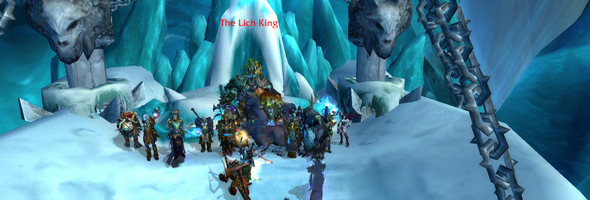
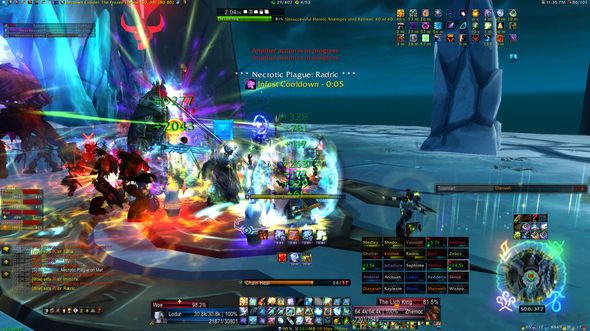
What is missing from the Arthas fight?

First before I begin I would like to say congrats to Matticus on his 10 man Arthas kill!

Now onto the matter at hand. My guild is plugging away at the Lich King 25 man encounter, our 10 man team is just about to take him down as well. There is a certain sense of accomplishment when you get to the end of not only the content, but let’s be honest in this case the entire point of the expansion! This entire expansion has geared us up for this fight. Egging us on, pushing us to greater heights and taunting us at every turn. The Lich King has been found in so many quests, instances and cinematic events it is impossible to not want to kill him.

When Trial of the Crusader was released, I’ll be honest I was not impressed. In fact I down right hated ToC. I’m an old school raider, I like instances with trash and having to work at getting TO the boss. I mean in every book I’ve read the hero and the villain don’t just run into each other randomly and just go to town. The hero normally goes through various trials and or henchman before they get to the big bad. In James Bond movies, he has to go through the henchman before making his way to the final bad guy for the show down. To me that is what trash is in an instance, it is a warm up but it’s also story fodder. These are the creatures the various bosses thought good enough to guard them from US. So when I walked into ICC for the first time you can bet I was over-joyed at the amount of trash that lay before us. One of my fondest memories as of late was when we were first heading into the Plagueworks, I was flying solo leading the raid that night and we were coming up on Stinky and Precious. I didn’t warn the raid about them at all, instead as we pulled I laughed maniacally at the frantic screams of “HOLY SHIT WHAT THE HELL IS GLUTH DOING HERE?” as the raid wiped. Everyone laughed about it afterward  and I felt happy that there was trash that was actually DANGEROUS if you weren’t prepared.

My guild has fought our way through all the bosses up to Arthas and there is a sense of accomplishment there. The fight itself is amazing fun, if for no other reason than because there is so much going on. So, why then am I feeling slightly ripped off with this fight?

Arthas is one of those lore characters that has shaped this game. Warcraft 3 was a game I played to death and out of it what I got was the setup for World of Warcraft. It was heart-wrenching when Arthas slew his father and you saw the darkness in complete control, it was epic when Illidan and Arthas fought. The story, even though it was an RTS, was colorful and rewarding.

So last night Unpossible was working on Arthas and I couldn’t shake the feeling that something was wrong with the fight, that something was missing. After the raid I thought back to burning crusade and Black Temple. The Illidan fight felt epic. The scene opened up with Akama going to face Illidan and speak his peace, followed by him running off to hold off reinforcements and give the group time to deal with Illidan. Partway through the fight, a fed up Warden Maiev Shadowsong bursts in to help try and take down the demon prince. He had wronged her so much that she had to have her revenge. In short the fight felt epic. It felt like great payoff to all the work of getting there. I attribute this to a well designed encounter, but a lot of that had to do with NPC interaction.

When you reach Arthas there is a small back and forth between the fallen prince of Lordaeron and Tirion Fordring. To be honest the back and forth is a little weak, and Tirion is one of those characters I could do without. I mean, of all the people Arthas has pissed-off and messed with over the years they picked Tirion to be the one to confront him. I mean I guess I expected him to be there from the beginning, after all he is the bearer of Ashbringer, but I expected someone faction specific to be there along side him as well. I know Jaina and Sylvanas made an appearance in the 5 mans, but this is the big show, the big payoff. Personally I expected them to be there, or rather someone who Arthas has wronged on a deep personal level to be there.

Before you say anything yes I know the history of what happened between Arthas and Tirion and the subsequent exile. My point though is as fun as the fight is (it IS an amazingly designed encounter), it just doesn’t feel as epic as I think it should.

We have airships right? After we’ve taken down the Frost wing, why not have the ship fly up to assault Arthas only to have him blow it out of the sky? How about King Varian Wrynn or Thrall gets to deliver the epic speech debasing Arthas and spurring us to victory. Instead we get Tirion running forward, and getting hunter trapped.

I still love the encounter don’t get me wrong. I love the fact that there are a thousand things you have to watch for and so many ways you can die. I like having fights that have consequence and Defile is the greatest thing EVER created (no sarcasm on that). I guess in the end I just wish there was a little more NPC interaction at the end to help lend the cinematic / literary climactic feel that the encounter truly deserves.

What do you think about the encounter?

So with that I bid you all a good day, hopefully next week I’ll be writing you as King Slayer Lodur. Until next time, Happy healing and may all your heals be swift and your mana plentiful!